
What Does Eco-Friendly Candle Packaging Actually Mean?
Four terms, four different claims. Using the right one is the difference between a defensible statement and a liability.
Recyclable
Means the material can be reprocessed but only if a local scheme accepts it. Plain paperboard is widely accepted; a box with lamination, foil or a plastic window frequently is not, even though it is mostly paper. Recyclable in principle and recyclable in practice are different claims, and customers judge you on the second.
Recycled Content
Describes what the material is made from, not what happens to it afterwards. A box can be 100% recycled and still end up unrecyclable if it is laminated. This is the most measurable of the four claims and the easiest to state accurately, because your supplier can tell you the percentage.
Biodegradable
Means it breaks down eventually, which is close to meaningless without a timeframe and conditions attached. Almost everything is biodegradable on a long enough horizon. Unqualified, this is the weakest term of the four and the one most likely to attract scrutiny.
Compostable
Means it breaks down into non-toxic matter under defined conditions, and the conditions matter enormously. Industrially compostable requires a commercial facility most customers cannot access. Home compostable is a much stronger claim and a much rarer one. Never use the two as synonyms.
Materials That Genuinely Reduce Impact
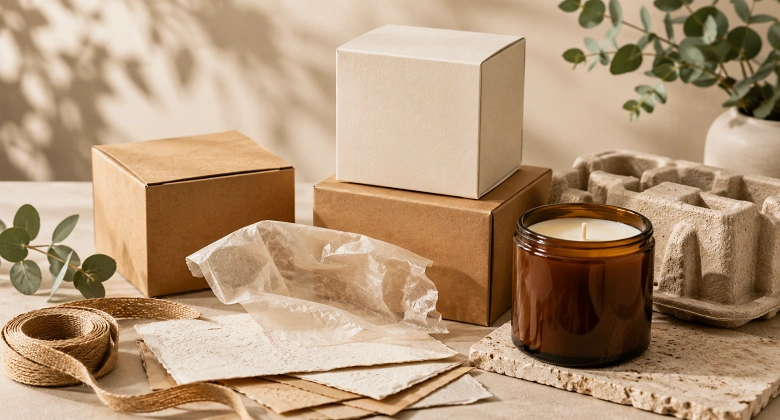
Most eco-friendly candle packaging starts with recycled or kraft board, and for good reason. Kraft has a second advantage worth knowing: it hides handling marks far better than bleached white, so packaging stays looking new through more of its retail life. One caveat that often surprises people kraft is not automatically greener than white board. Kraft describes the color and pulping process, not the fiber source. Virgin kraft is still virgin fiber. Ask for recycled content or certified sourcing rather than assuming the brown tone means something.
Uncoated stock is the quiet winner in sustainable candle packaging. It skips the lamination step entirely, which keeps the box recyclable and removes a production pass, and it takes embossing beautifully so it can be the premium choice and the sustainable one at once. Soy and vegetable-based inks are a straightforward substitution with no downside in quality.
The largest lever, though, is using less. A dust cover uses a fraction of the material of a carton and does most of the protective job on a retail shelf. Our candle dust covers are die-cut from kraft or linen-textured recycled paper and sized from small votives up to 16 oz jars, the lowest-footprint way to turn a bare vessel into a branded product. Eliminating a component always beats substituting one.
What Makes a Candle Box Actually Recyclable?
A single material. That is the whole answer, and it is why recyclable candle boxes are harder to achieve than most eco-friendly candle packaging suggests; nearly every premium finish creates a composite.
- A plastic film fused to the board. The most common reason an otherwise recyclable box is rejected.
- Foil stamping. Small areas are often tolerated; extensive coverage is not.
- PET and PVC films must be separated by hand. Some schemes reject the whole box.
- Plastic and foam inserts. Recyclable separately at best; usually not at all.
- Ribbons, magnets and closures. Contaminants in a paper stream.
The workable approach is not to eliminate every finish but to know which ones you have and describe the box accordingly. A laminated box with a foam insert is not recyclable as a unit, and saying so plainly costs less trust than a blanket claim that falls apart on inspection.
Biodegradable Candle Packaging: The Honest Version
Uncoated paper and board genuinely biodegrade, and for most candle brands that is the realistic extent of it. Where biodegradable candle packaging gets oversold is in films and coatings; compostable window films and bio-based laminates exist, but they typically have shorter shelf lives, sometimes need a secondary barrier, and usually require industrial composting that your customer has no access to.
If you use them, qualify the claim: name the material, name the conditions, and say where it can actually be processed. A specific, limited claim is more persuasive than a broad one, because it reads as knowledge rather than marketing.
Can Eco-Friendly Packaging Still Feel Premium?

Yes, and the two goals overlap more than they conflict. Weight and texture drive perceived value, and both are available without lamination: heavy uncoated stock, rigid board wrapped in textured recycled paper, blind embossing rather than foil, and a single-color print on kraft all read as considered rather than cheap.
The genuine tension is with high-gloss lamination, large foil coverage, and plastic windows, all of which create composites. Dropping those is a design constraint, not a downgrade, and it pushes you toward restraint, which is where most premium design ends up anyway. Our guide to choosing luxury candle packaging covers which finishes carry the most perceived value per dollar spent, several of which are compatible with a single-material box.
The Wax Melt Problem
Wax melts deserve a specific mention because the category has the sharpest gap between positioning and packaging. Melts sell on natural, soy-based, home-fragrance credentials, and the default pack is a molded plastic clamshell that most curbside schemes will not take.
The alternatives each trade something. Our wax melt boxes are made from recycled board and die-cut to fold cleanly, which solves the material story, but any pack holding bare wax needs a barrier, and barriers are where composites creep back in. The full comparison of clamshells, boxes and bags on fragrance retention and cost is in our guide to wax melt packaging.
Verify Sustainability Claims Before Printing Them
Environmental language should describe a documented packaging attribute, not create a general impression that the entire package is environmentally preferable.
The FTC Green Guides advise marketers not to make broad, unqualified environmental-benefit claims. A claim should identify the specific benefit, explain important limitations and be supported by appropriate evidence.
Before approving packaging copy, verify:
The recycled-content percentage
The source and certification of the fiber
Every coating, laminate, adhesive, window and insert
Whether different components must be separated
The disposal conditions required
Whether appropriate collection or processing facilities are available
Whether the wording remains accurate in each sales market
Certification claims also need careful wording. FSC certification concerns responsible forest sourcing and chain of custody; it does not automatically mean that every finished package is recyclable, biodegradable or compostable. The Forest Stewardship Council’s label guidance explains the differences among FSC 100%, FSC Recycled and FSC Mix.
Keep supplier documentation for every environmental statement and review the claim whenever the material, finish or packaging configuration changes.
Common Greenwashing Mistakes

Most greenwashing in this category is accidental: a brand overstating sustainable candle packaging credentials it genuinely believes it has. These are the six that come up most often:
- Blanket claims on mixed materials. One green statement covering a laminated box with a foam insert.
- Using biodegradable and compostable interchangeably. They are different claims with different conditions.
- Assuming kraft equals sustainable. Brown board can still be virgin fiber.
- Claiming recyclability without checking acceptance. Locally accepted matters more than technically possible.
- Adding an eco-insert to a plastic-windowed box. The weakest component defines the pack.
- Over-packaging a sustainable product. Three layers of recycled board is still three layers.
Final Thoughts
The most useful principle in eco-friendly candle packaging is that reduction beats substitution. A smaller box in plain recycled board with no laminate outperforms an elaborate pack in a marginally better material, on impact and usually on cost.
The second is that precision beats enthusiasm. Customers in this category are informed, and a specific claim of recycled content stated as a percentage, or a component described accurately, earns more credit than a broad one. Say less, and be able to prove it.