
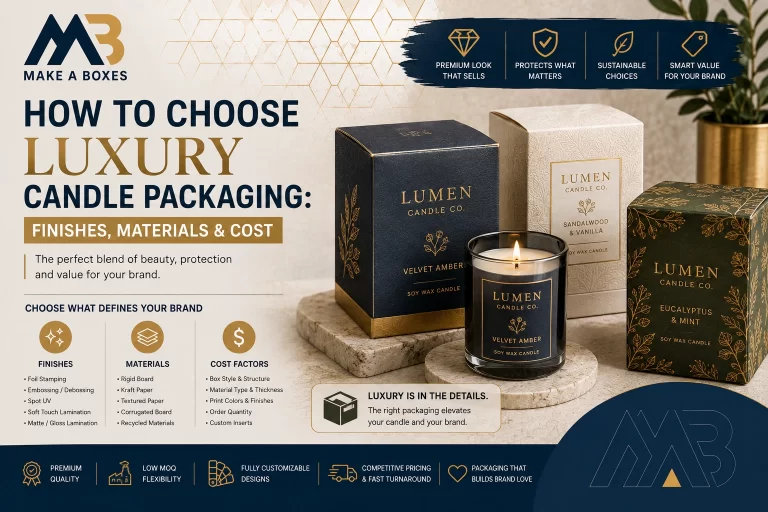
What Actually Makes a Box Feel Premium?
Three things, in this order: weight, texture, and how the box opens. Most luxury candle packaging ideas concentrate on the fourth category, decoration, which is the one a customer registers last.
Weight comes first because it is registered before the customer has consciously looked at anything. A rigid box wrapped in heavy paper feels substantial in the hand in a way no folding carton does, and that impression is formed in under a second. It is also the hardest signal to fake: thin board with an expensive finish reads as a cheap box with an expensive finish.
Texture is the second. Uncoated, textured, and linen-finish papers give the fingertips something to register; high-gloss lamination gives them nothing, which is why gloss has drifted downmarket over the last decade. Soft-touch lamination sits between the two and is the single most cost-effective tactile upgrade available.
The opening motion is third and most underrated. A lid that lifts with slight resistance and settles, a drawer that slides, a ribbon pull these create a moment. A tuck flap does not. This is a structural decision, not a finishing one, which means it has to be made early.
Materials: Where Perceived Value Comes From
Our luxury candle packaging is built from high-density chipboard wrapped in high-grade textured paper, which is the standard construction for premium presentation across the category. The chipboard provides rigidity and weight; the wrap provides color, texture, and print surface. They are specified separately, and both matter.
Board thickness is where brands specifying custom luxury candle boxes most often underspend. Moving from a folding carton to rigid board is the largest single jump in perceived value available, and it costs more in freight than in material, because rigid boxes do not ship flat. Wrapped papers give you options a printed carton cannot: linen and laid textures, uncoated stocks that take embossing beautifully, and dark papers that hold depth rather than looking flat.
Finishes Compared
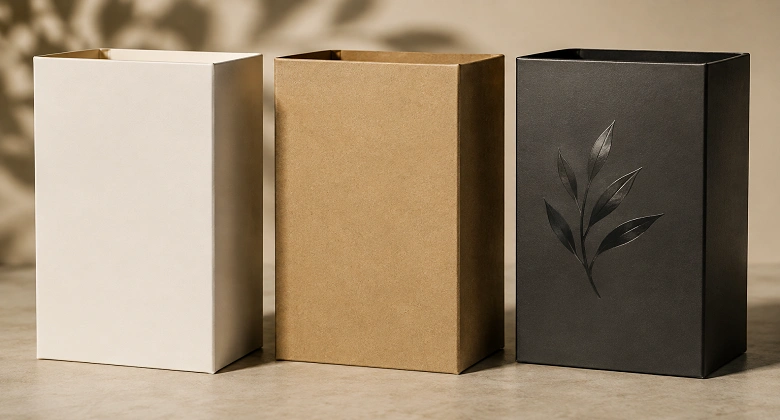
Each finish adds a separate pass through a machine, and each pass carries its own setup cost. That is why adding two finishes rarely costs twice as much; it often costs more.
Foil Stamping Candle Boxes
Foil is the strongest single premium signal per dollar spent, because nothing else in print catches light the same way. It works best on simple marks a wordmark, a monogram, a thin rule and poorly on detailed illustration, where fine lines fill in. Foil stamping candle boxes on a dark textured wrap is close to a category shorthand for premium, which is both its strength and its limitation: it is a well-worn look, and it will not by itself distinguish you.
Embossing and Debossing
Blind embossing a raised or recessed mark with no ink or foil is the most restrained option available and reads as confident rather than showy. It needs uncoated or lightly coated stock with enough caliper to hold the impression; on thin or heavily laminated board the effect flattens out, and the cost is wasted.
Soft-Touch and Spot UV
Soft-touch lamination gives a velvety surface that changes how the box feels without changing how it looks, which makes it unusually good value. Spot UV works by contrast gloss over matte so it only reads on a matte or soft-touch base. Applied over gloss, it disappears, which is a common and expensive specification error.
Why Black Candle Boxes Work and What They Demand
Black is the default premium color in this category for good reason. It recedes visually, so foil and spot UV sit forward against it. It photographs well. And it carries no seasonal or fragrance association, which means one structure can serve a whole range.
What black demands in return is production discipline, and this is where custom black candle boxes go wrong more often than any other specification. Dark stock shows everything: fingerprints, scuffs from handling, and white cracking along scored folds where the coating splits. Three things prevent it: a matte or soft-touch laminate rather than a bare printed surface, careful scoring specification so folds do not crack, and, where budget allows, a dyed-through black board instead of black ink on white stock, so any nick at an edge does not flash white.
Our custom black candle boxes are worth reviewing alongside samples of a paler alternative. Black looks decisive on screen and is genuinely less forgiving in a warehouse, and that trade-off is easier to judge in the hand than in a proof.
Which Structures Read as Premium?
- Rigid two-piece lid and base. The category benchmark. Maximum weight and the cleanest reveal. Does not ship flat.
- Sliding drawer. Distinctive motion, strong for gifting, slower to pack.
- Magnetic closure. The most theatrical opening. Costliest option, and the magnet adds weight to every package.
- Sleeve over rigid tray. Splits artwork from structure, useful for seasonal editions on a fixed vessel.
- Heavy folding carton with finishes. The entry point. Ships flat, costs the least, and will not match rigid on weight.
What Does Luxury Packaging Actually Cost?
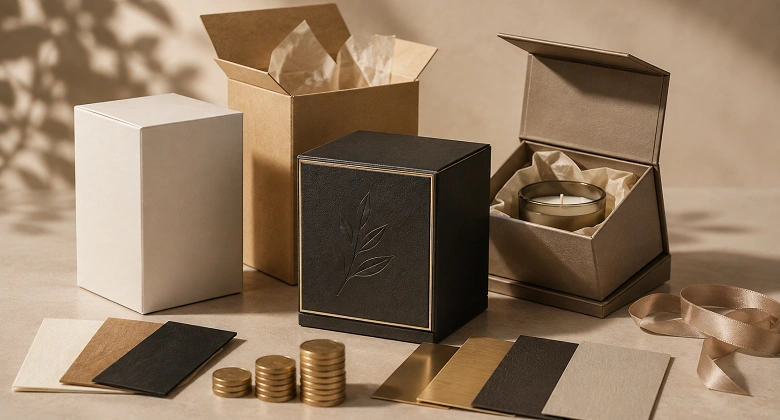
The unit price is the visible cost and rarely the largest one. Rigid boxes arrive assembled, so you pay more in inbound freight and hold more warehouse space per unit than flat cartons. Each finish carries a setup charge, which means reorders and small runs are disproportionately expensive. And specialty papers have their own lead times, which can dictate a launch date.
There is also a flexibility cost worth naming. A specification with foil, emboss, and soft-touch is expensive to repeat at low volume, so brands sometimes drop a finish on the reorder, and the packaging visibly changes between runs, which undoes the consistency the spend was meant to buy. Specify what you can afford to reorder.
How to Choose Luxury Candle Boxes for Your Brand
Luxury candle packaging ideas are easy to collect and hard to prioritize. A workable order when the budget will not cover everything:
- Structure first. Weight and opening motion do more than any finish and cannot be added later.
- Then substrate. Textured or dark wrapped paper over a rigid body.
- Then one finish, done well. A single clean foil mark beats three competing treatments.
- Then the interior. A fitted insert and a printed inner surface extend the moment past opening.
The test for any upgrade is whether a customer would notice its absence. Most would notice a flimsy box or a lid that does not settle. Fewer would notice spot UV. Spend accordingly. Where the packaging is doing gifting work as well as retail work, our guide to candle display, gift and subscription boxes covers presentation formats in more detail.
How to Evaluate the Luxury Candle Packaging Suppliers
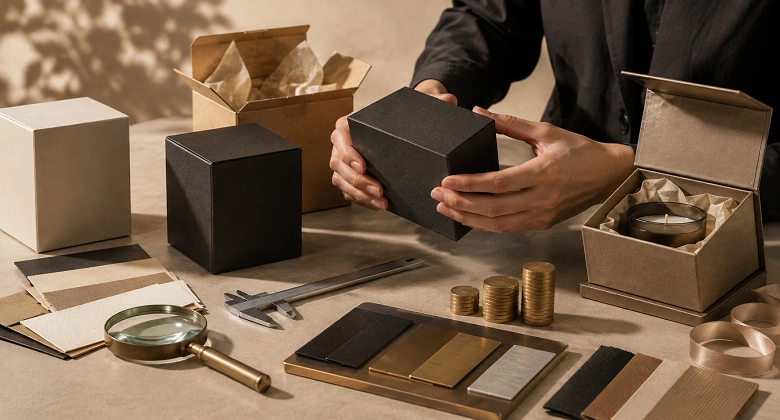
Judging luxury candle packaging suppliers on portfolio images is unreliable, because renders flatter and photography hides board weight. Three checks are more informative: ask for physical samples of a comparable build rather than a swatch pack; ask what board caliper and paper weight they are actually quoting, and get it in writing; and ask what happens on a reorder specifically, whether the setup charges recur and what the minimum is for a repeat run.
A supplier who answers those three plainly is easier to work with than one with a better-looking website.
Common Mistakes in Premium Candle Packaging
- Finishes on thin board. Foil on a flimsy carton reads as trying, not as premium.
- Stacking treatments. Three finishes competing for attention cancel each other out.
- Spot UV over gloss. No contrast, no effect, full cost.
- Black without protection. Bare dark stock scuffs and cracks at folds.
- Ignoring freight and storage. Rigid boxes ship assembled and take real warehouse space.
- Overclaiming sustainability. Laminated, foiled boxes are composites; describe components honestly, as covered in our sustainable candle packaging
Final Thoughts
The most useful reframe for anyone weighing luxury candle packaging ideas is that luxury is structural before it is decorative. Weight, texture, and the way a box opens do the work; finishes confirm an impression that has already formed. A rigid box in a good textured paper with one clean foil mark will outperform a thin carton carrying every treatment on the list, and it will usually cost less.
If you are choosing between options now, get physical samples of two builds at different price points and hand them to someone outside the business without explanation. Which one they pick up first tells you more than any spec comparison will.