
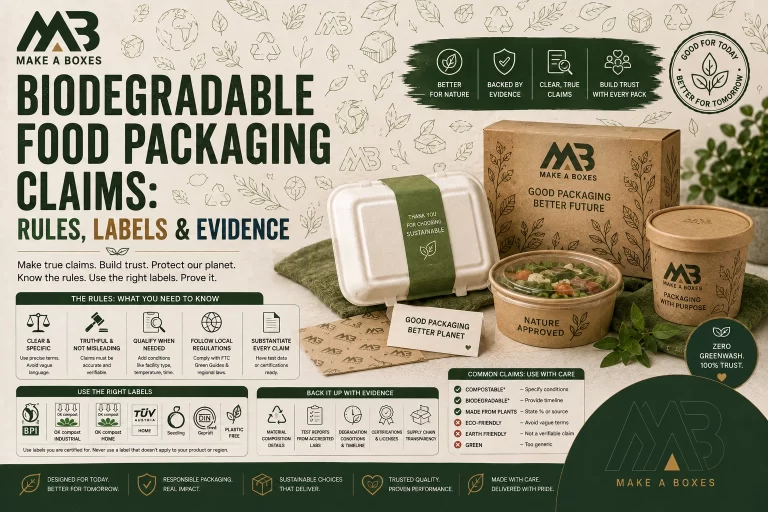
Why “Eco-Friendly” Is the Weakest Word You Can Use
“Eco-friendly food packaging” and “sustainable” as standalone claims are effectively unsubstantiable. They describe a direction rather than a property; they cannot be measured, and regulators treat vague general claims as deceptive precisely because a consumer cannot verify them.
The alternative is not to say less about eco-friendly food packaging. It is to say specific things: what the material is, what percentage is recycled, what certification it holds, and what a customer should actually do with it. A specific claim is both more defensible and more persuasive, because it reads as knowledge rather than positioning.
Which Certifications Actually Back a Claim?
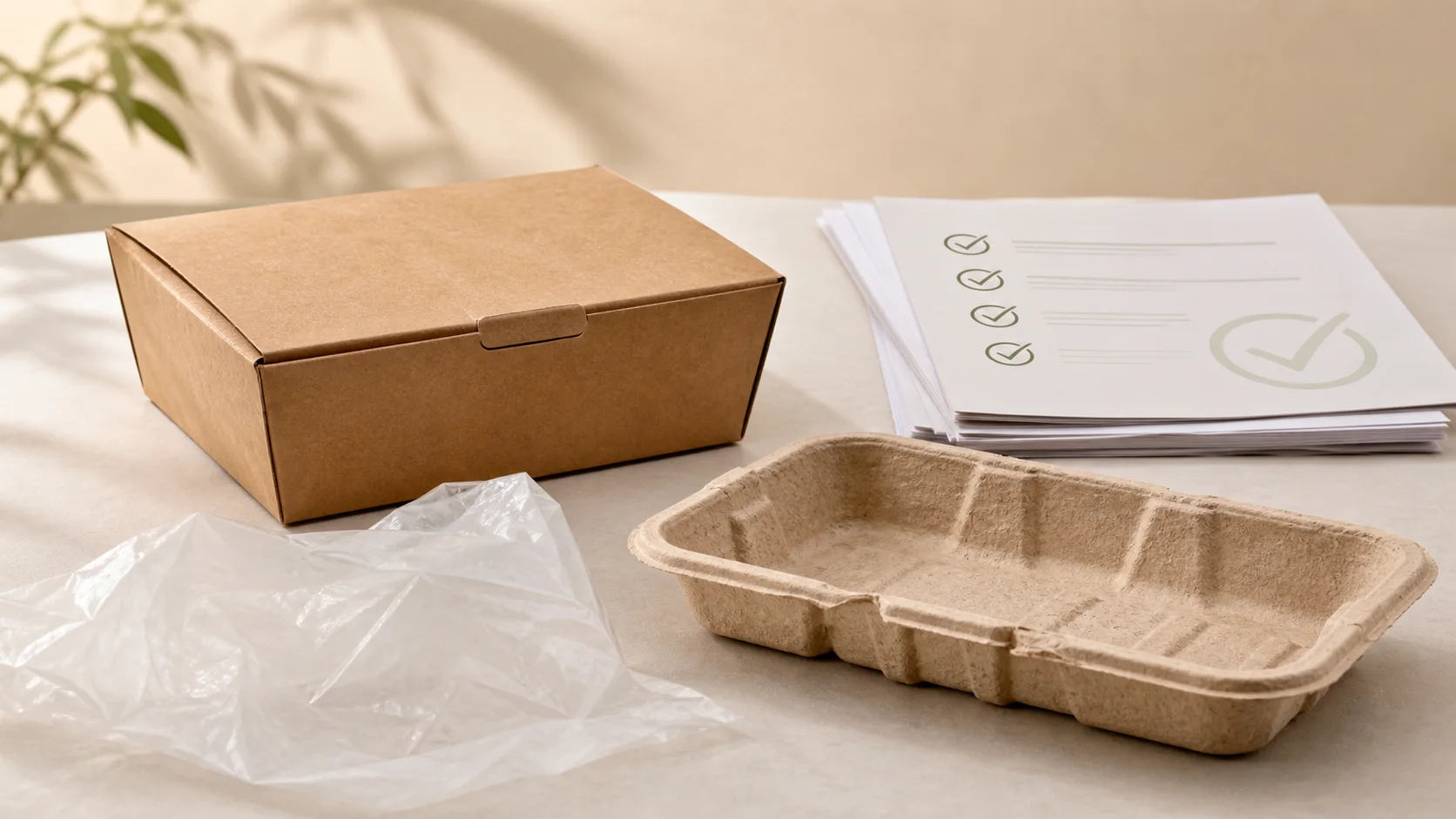
This is the part most biodegradable food packaging content skips, and it is the part that matters. A certification is the difference between a claim and an assertion.
| Standard / Mark | What It Covers | Where It Applies | What to Ask For |
|---|---|---|---|
| ASTM D6400 | Compostable plastics in industrial facilities | US | Certificate naming the finished item |
| ASTM D6868 | Coated paper and board with compostable coatings | US | Applies to the coated article, not just film |
| EN 13432 | Industrial compostability | EU | Relevant if you export |
| BPI certification | Third-party verification against ASTM standards | US | BPI listing for the specific SKU |
| TUV OK compost INDUSTRIAL | Industrial composting only | EU / international | Do not conflate with HOME |
| TUV OK compost HOME | Breaks down in domestic composting | EU / international | Much stronger and much rarer |
| FSC | Responsible fiber sourcing | Global | Chain-of-custody documentation |
Two traps worth naming when certifying biodegradable food packaging. First, certification usually applies to a specific finished article, not to a material in general; a compostable film certified in isolation does not certify the box it is laminated to. Ask for documentation naming the item you are buying. Second, home and industrial compostability are entirely different claims, and using them interchangeably is one of the most common failures in compostable food packaging labeling.
The Composting Infrastructure Problem
Compostable food packaging can be genuinely certified and still, in practice, end up in landfill because certification describes what a material can do under defined conditions, not what will happen to it.
Industrial composting requires a commercial facility, and access varies enormously by region. Many facilities also decline compostable packaging outright, because operators cannot reliably distinguish certified items from conventional lookalikes and because packaging often does not break down within their processing cycle.
The federal position on degradable claims reflects this. Guidance requires substantiation that the entire item breaks down within roughly a year of customary disposal, and items that end up in landfills, incinerators, or most recycling facilities typically do not meet that standard. That is why an unqualified “biodegradable” claim is among the hardest to defend, and why a qualified claim naming the conditions is the only sensible form.
What the Labeling Rules Now Require
Two frameworks govern claims on biodegradable food packaging in the US, and they no longer say the same thing.
The Federal Position
The FTC Green Guides explain how the Federal Trade Commission evaluates environmental marketing claims. They are guidance rather than a product certification, and they do not replace additional state requirements.
The current Guides advise against broad, unqualified environmental-benefit claims such as “green” or “eco-friendly.” Recyclable, compostable, degradable and recycled-content claims should identify the specific attribute, disclose important limitations and be supported by competent and reliable evidence.
As of August 2026, the FTC continues to list the Green Guides as under review, while the 2012 guidance remains the current published version. Brands should check the FTC’s current Green Guides review page before approving new environmental copy.
Federal guidance is a baseline, not a guarantee that the same wording is acceptable in every state or market.
California Has Moved Ahead
California’s SB 343 establishes specific requirements for recyclability labels and the use of chasing-arrows symbols or other recyclability indicators.
CalRecycle states that the labeling restrictions apply to products and packaging manufactured after October 4, 2026. Products and packaging manufactured before that date are not subject to those restrictions, regardless of when they are sold.
The CalRecycle SB 343 guidance provides the current implementation dates, final material-characterization findings and subsequent updates.
Before using a recyclability claim in California:
Identify the complete packaging construction
Review the current CalRecycle findings and updates
Confirm whether the material is regularly collected and processed
Evaluate coatings, laminates, labels and other components
Retain the evidence used to approve the claim
Recheck the assessment whenever the package changes
Do not assume that federal guidance alone resolves California requirements. Obtain appropriate legal or compliance advice when approving market-specific labeling.
Materials That Genuinely Work for Food
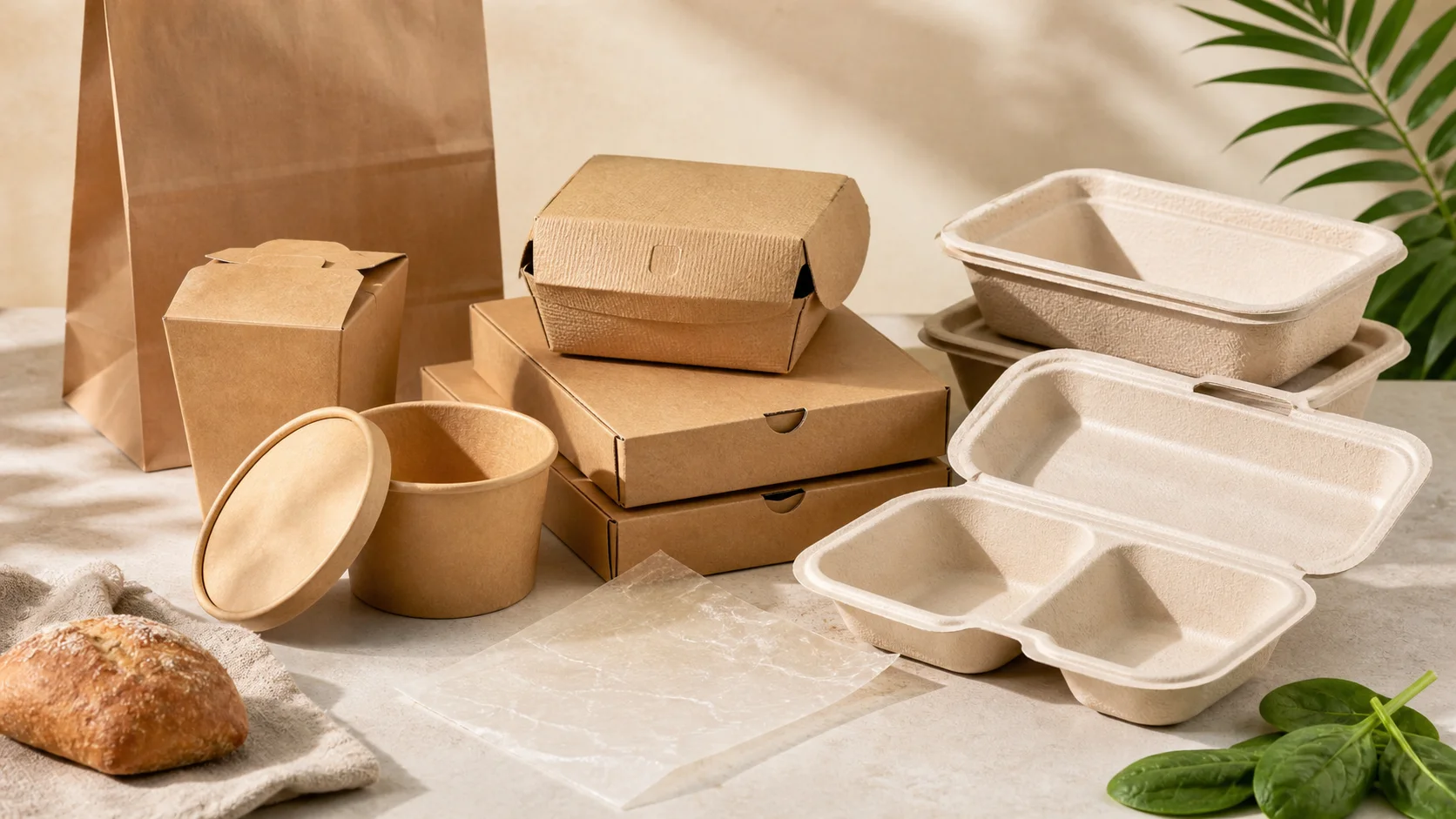
Setting the labeling aside, some sustainable food packaging options do straightforwardly reduce impact.
For eco-friendly food packaging, uncoated recycled and kraft board is the most reliable option, because it is single-material and widely accepted. Plain paperboard is one of the few substrates with real recycling infrastructure behind it across most of the country.
Molded fiber trays and bagasse are made from agricultural residue and are genuinely lower-impact at the input end, though as noted above their end-of-life story is weaker than the marketing suggests. Plant-based and non-fluorinated grease coatings are the mainstream replacement for fluorinated treatments and perform well for most applications, coating types, and where each suits are covered in our custom wax paper guide.
Our biodegradable food packaging range covers the formats available. The honest framing for all of them is that each solves part of the problem, and none solves all of it.
The Food Residue Problem
This is the constraint that undermines more recyclable food boxes and sustainability plans than any material choice, and almost nobody accounts for it at the specification stage.
Recyclable food boxes and biodegradable food packaging alike stop being recyclable once food touches them. Grease, sauce and residue cause rejection in fiber streams regardless of what the board is made from or how much recycled content it contains. A pizza box, a fry carton and a used burger wrap are waste or compost questions, not recycling ones.
Two consequences follow. Packaging that separates a clean outer carton with a soiled liner inside lets the customer recycle the part that stayed clean, which is materially better than a single soiled unit. And for anything that will be heavily soiled in use, certified compostability is a more honest goal than recyclability, provided the composting claim is properly qualified.
Reduction Beats Substitution
The most effective sustainable food packaging decision is usually not to switch material but to use less of it. Reduction outperforms every substitution on this list.
A wrapping sheet instead of a carton, one component instead of three, a right-sized box instead of a generous one each removes material outright rather than trading one imperfect option for another. It is also the only approach with no downside claim risk, because using less requires no certification and invites no scrutiny.
Weigh food waste in the balance too. A pack that fails and spoils product has a far larger footprint than the packaging it saved, which is why barrier performance and sustainability genuinely conflict in some categories, especially frozen, as covered in our frozen food packaging requirements.
What to Ask Your Supplier
- What certification does the finished item hold? Not the material the article you are buying, named on the certificate.
- Is compostability home or industrial? They are different claims, and industrial requires facility access.
- What is the recycled content percentage, and is it verified? This is the most measurable claim available to you.
- Is the pack single-material or a composite? Coatings, laminates, and liners decide this, not the board.
- What replaced the fluorinated grease coating? “PFAS-free” is a claim; the replacement is the specification.