
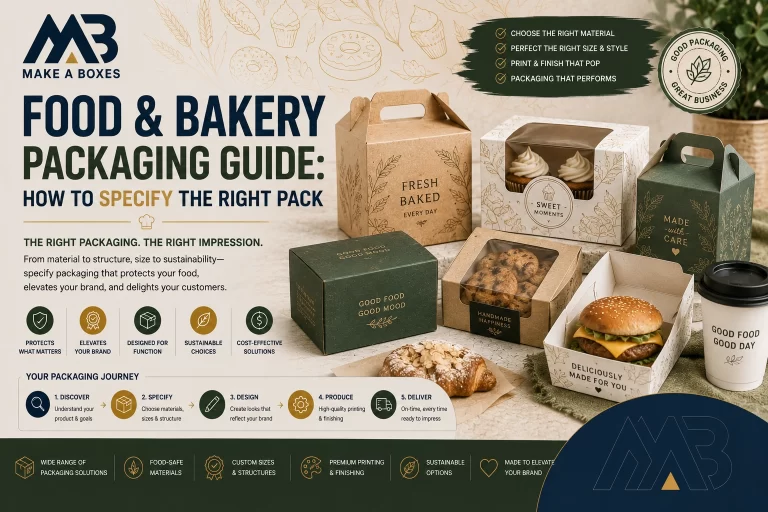
Food packaging is the only category where the box is part of the product experience rather than a wrapper around it. It touches what the customer eats. It has to survive grease, steam, condensation, and a delivery driver’s back seat. And it gets judged in the two seconds between a bag being opened and a meal being seen long before anyone tastes anything.
That combination makes custom food packaging a harder brief than most categories, and it is why so much of it fails in predictable ways: soggy bases, grease showing through print, cake boxes that sag under their own contents, freezer cartons that arrive damp. Almost all of those are specification problems rather than manufacturing ones.
This guide covers custom food packaging in one place: the materials that are safe to put against food, the three failure modes that account for most complaints, the structures that suit bakery, takeout, frozen, and beverage products, and how ordering actually works. Each section links to a deeper guide with more detail.
Working out what your product needs? → Get a Free Quote from Make A Boxes
What Makes Food Packaging Different?
Three things separate custom food packaging from every other category, and each one adds a constraint that does not exist elsewhere.
It Is in Direct Contact With Food
A cosmetic carton never touches the product. A pastry box does. That means the board, the coating, the ink, and the adhesive all have to be suitable for food contact, not just the surface the food rests on, because migration through a substrate is a real mechanism. This is the one area of food packaging where getting it wrong is not a quality problem but a safety one.
It Fails in Ways Other Packaging Does Not
Grease penetrates. Steam condenses. Heat softens coatings and warps board. Cold makes fibers brittle and pulls moisture out of the air onto every surface. None of these are impact damage, which is what most packaging is designed against; they are slow chemical and physical processes that a drop test will never reveal.
It Is Judged Immediately and Visually
A grease spot on a printed panel reads as poor quality even when the food inside is perfect. A collapsed corner on a cake box reads as damage. Food packaging carries an unusually short path between a physical flaw and a lost customer, which is why the structural decisions matter as much as the printed ones.
Food-Safe Materials: The Layer You Cannot Compromise
Every other packaging decision balances cost, appearance and performance. Food-contact suitability is a safety and compliance requirement.
In the United States, the FDA regulates food-contact substances rather than approving a custom box as one complete product. The regulatory status of a finished food-contact material depends on its individual components and intended conditions of use. The FDA’s food-contact-material guidance explains the applicable authorization pathways.
In practice, evaluate the complete construction:
Board or paper
Coating or barrier
Ink
Adhesive
Window film
Liner or insert
The correct material depends on whether contact is direct or indirect, whether the food is dry, wet or fatty, the contact temperature and how long the food remains inside the package. Ask the supplier for documentation that covers the intended application rather than relying on a general “food-safe” or “FDA-approved” statement.
Our guide to food-safe packaging materials explains the relevant material grades, coatings, inks and compliance documentation.
The Three Failure Modes
Almost every complaint about custom food packaging traces back to grease, moisture or heat. Designing against all three at once is what separates packaging that works from packaging that photographs well.
Grease
Fats and oils wick into uncoated fiber and show through as translucent patches, usually within hours for hot food and within days for baked goods. The fix is a barrier: a grease-resistant coating on the board, a liner between food and box, or a wrapping sheet doing the work instead.
Wax paper and greaseproof sheets are the most flexible answer because they solve the problem at the point of contact rather than requiring a more expensive box. Our custom wax paper guide covers paper bases, coating types, sheet sizing and which combination suits which food.
Moisture and Condensation
Moisture moves in both directions, and both are problems. Steam trapped inside a closed box condenses and softens the base, which is why hot food packaging often needs deliberate ventilation rather than a better seal. Cold products face the opposite: condensation forms on the outside as a pack moves from freezer to ambient, and repeated cycles can delaminate a coating or lift printed ink.
Heat
Heat softens coatings, weakens adhesives, and can warp a board panel enough to break a closure. It also accelerates grease migration. Any pack that holds hot food, or that might be reheated, needs its temperature range confirmed rather than assumed; the difference between a wax-coated sheet and a silicone-coated one is exactly this.
Bakery Packaging
Bakery is the most structurally demanding part of the category, because the products are heavy, fragile, and sold on appearance all at once. A cake is not protected by being enclosed; it is protected by not moving and by nothing touching it.
Which Bakery Box Styles Are Used?
The core formats are tuck-top and auto-lock cartons for cookies, muffins and pastries; windowed boxes where the product’s appearance sells it; compartmented boxes for cupcakes and macarons, where a divider prevents contact damage; and rigid or reinforced boxes for larger cakes. Bakery packaging generally uses a heavier caliper than takeout because the load is higher and the dwell time on a shelf is longer. Sizes and structures by product type are set out in our bakery box styles and sizes guide.
Cake Boxes and Load
Cake packaging has to be specified around the complete packed product: cake weight, footprint, height, cake board, closure, refrigeration conditions and whether boxes will be stacked.
Paperboard caliper is only one part of the structure. A heavier board cannot compensate for an unsupported base, an oversized footprint or panels that do not lock correctly. Reinforced bases distribute the load across the footprint, while a close dimensional fit helps the sidewalls retain their intended shape.
Do not assign a load or stacking rating from board thickness alone. Test a filled production sample using the actual cake board, closure and handling conditions. Record any weight or stacking claim only when it is supported by repeatable testing of the final configuration.
See our cake box strength and sizing guide for detailed selection and testing guidance.
Windows and Presentation
A window sells a product that looks good and exposes one that does not travel well. Film-backed windows keep the pack closed while showing the contents; open cut-outs let moisture and odor move freely, which suits crusty bread and ruins a glazed pastry. Choose based on whether the product benefits from airflow or needs protection from it.
Takeout and Fast Food Packaging
Takeout packaging has the shortest use cycle in the category and the harshest conditions: filled hot, closed immediately, carried at an angle, and opened between ten and forty minutes later. The customer’s judgement is formed at that opening, not at the counter.
Three specification decisions drive most of the outcome. Ventilation determines whether steam condenses into the base; a fully sealed box is usually the wrong answer for hot food. Grease resistance determines whether the print survives the journey. And closure type determines whether the contents stay put in a delivery bag that is rarely kept level. Our takeout packaging guide explains each requirement by food type.
Frozen and Cold Chain Packaging
Frozen packaging inverts most of the usual assumptions. The pack spends its life at low temperature, where board becomes more brittle, and adhesives lose flexibility, then passes through condensation every time it moves toward ambient. Barrier performance against moisture, air, and odor transfer matters more than structural strength, because nothing is being dropped; it is being stored for months.
Barrier films, coated boards, and laminated structures all have a place here, and each carries a sustainability trade-off worth naming honestly rather than glossing over. Freezer conditions, barrier selection and condensation control are covered in our frozen food packaging requirements.
Beverage and Jar Packaging
Liquids and glass bring their own problems: weight concentrated low, breakage risk, and the possibility of leakage damaging everything around the product. Jarred foods, sauces, honey, preserves need a carton that holds the vessel still rather than merely containing it, and multi-jar packs need dividers so glass never touches glass.
Beverage formats add carrier strength and moisture from condensation on chilled products. Both are covered in our guide to beverage and jar packaging guide.
Structural Formats Used Across Food Packaging
Across every subcategory, custom food packaging keeps returning to the same handful of structures. What changes is the board specification and the barrier, not usually the geometry.
| Structure | Typical Use | Strength | Watch For |
|---|---|---|---|
| Tuck-top carton | Cookies, pastries, dry goods | Ships flat, prints well | Not for wet or hot contents |
| Auto-lock bottom | Takeout, heavier items | Fast assembly, strong base | Higher board cost |
| Windowed carton | Bakery, retail food | Shows the product | Film choice and cost |
| Compartmented box | Cupcakes, macarons, sets | Prevents contact damage | Insert adds cost and pack time |
| Reinforced / rigid | Cakes, premium retail | Load-bearing | Does not ship flat |
| Wrapping sheet/liner | Burgers, pastries, deli | Cheapest barrier | No structure at all |
Printing and Finishing on Food Packaging
Printing on custom food packaging carries one constraint the rest of the industry does not: ink must be suitable for the contact involved, and on direct-contact surfaces that usually means low-migration inks or keeping print off the food side entirely. Many food cartons are printed externally only for precisely this reason.
Beyond that, the usual finishing options apply with food-specific caveats. Gloss lamination resists grease well but adds a plastic layer that complicates recycling. Matte and soft-touch read as premium but mark more visibly, which matters on packs handled with greasy hands. Uncoated kraft hides marks best and is the most straightforward to recycle, at the cost of print vibrancy. Foil and spot UV work on retail food packaging but rarely justify their cost on takeout, where the pack is discarded within the hour.
Sustainability and Honest Claims
Food packaging is discarded quickly, which makes accurate material and disposal information especially important.
Recyclable, recycled content, biodegradable and compostable describe different attributes. None should be applied automatically to an entire package simply because its main component is paper or kraft board.
The FTC Green Guides advise businesses against broad, unqualified environmental-benefit claims. Claims should identify the particular benefit, explain relevant limitations and be supported by reliable evidence.
Evaluate every component separately:
Paperboard or fiber
Barrier coating or laminate
Window film
Adhesive
Liner
Insert
Closure
Recycling acceptance depends on the finished construction and the programs available where the package is sold. Compostable claims must distinguish between home and industrial conditions and explain when suitable facilities are required.
Our biodegradable food packaging claims guide explains how to assess materials and write more defensible environmental claims.
Sizing, Dielines and Fit
Food products vary batch to batch in a way manufactured goods do not: a hand-decorated cake, a filled sandwich, a portion of fries. Size to the largest realistic version rather than the average, and allow tolerance for a busy packing line where nobody is measuring.
Two rules cover most of it. Undersizing is more expensive than oversizing, because a box that does not close is scrap. Oversizing has its own running cost: product moves, presentation suffers, and dimensional weight raises shipping on every order. Get a dieline for your exact box and pack a real sample before approving a production run.
How Ordering Works: Wholesale, MOQs and Lead Times
Custom food packaging is priced around fixed setup costs: dieline creation, cutting dies, plate or press setup spread across the run. Food packaging boxes in a standard structure cost less to set up than a bespoke shape, which is why an unusual footprint can move a quote more than quantity does. That is why unit price falls sharply with quantity and why minimums exist at all. Digital printing avoids plate costs and makes short runs practical; offset gives better color and lower unit cost at volume.
For a business testing a new product or a seasonal line, a small first run is almost always the right call: it lets you see the pack in customers’ hands before committing to stock. For a proven seller on predictable volume, wholesale pricing is real money. Most food businesses end up running both. Our guide to food packaging MOQ and ordering guide covers what to prepare before requesting a quote and where costs actually sit.
Ready to spec your packaging? → Talk to Make A Boxes About Your Products
How Do You Choose a Food Packaging Supplier?
Portfolio images tell you very little. Renders flatter, photography hides board weight, and every food packaging supplier shows their best work. Four questions separate suppliers more reliably than a website does.
- What compliance documentation can you provide? Ask for food-contact compliance covering your contact type, temperature, and duration. A supplier who answers with “our materials are FDA-compliant” and can produce the paperwork is in a different category from one who says “food-safe” and stops there.
- What board caliper and coating are you actually quoting? Get it in writing. Two quotes for the same food packaging boxes can differ by several points of caliper, which is most of the price gap.
- Can I have a physical sample with my product in it? A sample with a real cake, burger, or jar in it answers questions no proof can.
- What happens on a reorder? Confirm whether setup charges recur and what the repeat-run minimum is, so your second order does not force a specification change.
The answers matter more in this category than in most, because a food packaging supplier who is vague about compliance is telling you something important. Everything else lead times, price, finish options is negotiable. That part is not.
Matching Custom Food Packaging to Your Channel
The same product often needs different packaging depending on how it reaches the customer, and this is where budgets get spent in the wrong place. Counter service needs speed of assembly and grease resistance above all; the pack is opened within the hour and discarded. Delivery adds tamper evidence, closure security and the reality that the bag will not be kept level. Retail shelving needs stacking strength, a printed facing and a longer barrier life, because the pack may sit for weeks.
Ecommerce is the most demanding of the four: the pack has to survive a courier network, arrive presentable, and often carry the entire brand experience with no shop or server involved. Custom printed food boxes earn their cost fastest here, because the unboxing is the only physical contact the customer has with the business.
Most food brands need two specifications rather than one, and the efficient way to run both is to keep the same internal fitment and vary only the outer.
Common Mistakes in Food Packaging
- Sealing hot food completely. Trapped steam condenses and softens the base. Ventilate deliberately.
- Uncoated board against fatty food. Grease shows through the print, usually within hours.
- Specifying by appearance, not load. Cake and multi-item boxes sag when the caliper is chosen for looks.
- Assuming a supplier claim is compliance. Ask for documentation covering your contact type, temperature and duration.
- Blanket eco claims on composite packs. A barrier-lined carton is not recyclable as a unit.
- Ignoring assembly time. Seconds per box become hours per week in a working kitchen.
- Approving a digital proof only. Screens show neither board texture nor real fit with the product.
Final Thoughts
The through-line across custom food packaging is that it fails at the interface where food meets board, where steam meets a closed lid, where weight meets an unreinforced base. Get the contact layer right, and the barrier right, and the rest is design.
If you are starting from scratch, work in this order: confirm what the material has to withstand, choose the barrier, then the structure, then the print. Doing it the other way round is how brands end up with beautiful packaging that shows a grease mark by the time it reaches the customer. You can browse formats on our custom food boxes and custom bakery boxes pages.
Ready to get started? → Get Your Custom Food Packaging Quote