
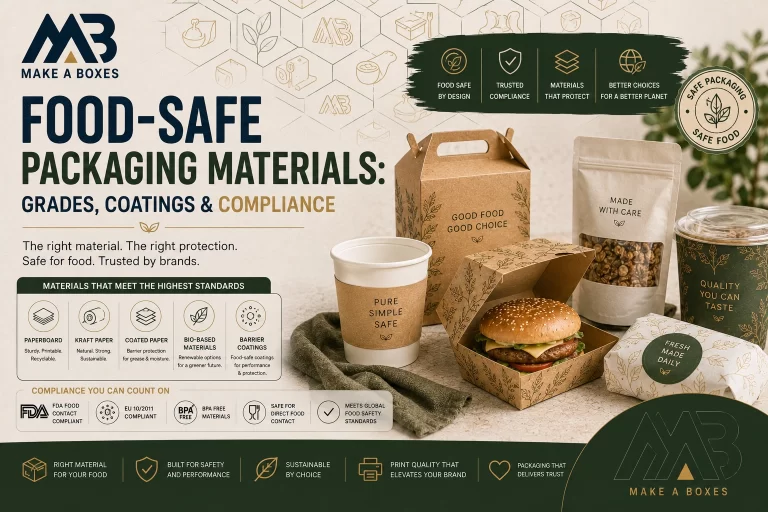
Choosing food-safe packaging materials is the one decision in this category with no acceptable margin for error. Every other specification is a trade-off between cost, appearance, and performance. This one is a legal and safety requirement, and getting it wrong is not a quality complaint but a recall.
It is also the area where the industry’s own language is least reliable. Suppliers describe food-safe packaging materials in terms that sound interchangeable and are not. “Food-grade” is used loosely, “food-safe” means different things to different suppliers, and “FDA-approved” is printed across thousands of packaging websites despite describing a status that does not exist. This guide sets out what actually governs food contact materials, which boards, coatings and inks qualify, what changed with PFAS rules, and the specific documentation worth asking a supplier for.
Note: this article is general information about packaging materials, not legal advice. Food-contact requirements differ by state and by market and are being amended frequently; confirm current obligations for where you sell before finalizing a specification.
Need materials confirmed for your product? → Get a Free Quote from Make A Boxes
What Makes a Packaging Material Food-Safe?
Food-safe packaging materials are safe for a particular use, not in the abstract. The same board can be entirely suitable for a dry cookie and unsuitable for a hot, oily burger, because the thing being controlled is migration: the movement of substances out of the packaging and into the food.
Three variables determine what a material has to withstand, and a supplier cannot answer the question without all three.
Direct or Indirect Contact
Direct contact means food rests against the surface. Indirect means something sits between them: a liner, a wrapping sheet, a sealed inner bag. Indirect contact is a materially lower requirement, which is why a wrapping sheet is often the cheapest route to a compliant pack: it lets the outer carton be specified for structure and print rather than for contact.
Temperature and Duration
Migration accelerates with heat and with time. A carton holding a chilled sandwich for two hours faces a fraction of the exposure of one holding hot fries, and both differ from a cereal box storing dry product for a year. A material suitable for ambient dry contact may not be suitable at serving temperature.
Food Type: Fatty, Aqueous or Dry
Fats are the aggressive case. Oil pulls substances out of a substrate far more readily than water does, and dry food is the least demanding of the three. This is why grease is both a cosmetic problem and a compliance one; the same mechanism that shows a stain on the outside of a box is moving material in the other direction.
How Are Food Contact Materials Regulated in the US?
This is where most packaging content gets it wrong, so it is worth being precise.
Why “FDA-Approved Packaging” Does Not Exist
The FDA does not approve boxes. It regulates food-contact substances, the materials, coatings, inks, and adhesives that may become components of food through contact and does so through defined conditions of use. There is no FDA approval certificate for a carton, and any supplier offering one is describing something that is not real.
The accurate term is FDA-compliant packaging: packaging built from substances that are permitted for the intended contact conditions. That is a claim a supplier can substantiate with documentation. “Approved” is not.
The Pathways a Material Can Take
A substance can be cleared for food contact through several routes: an existing food additive regulation covering that class of material, a Food Contact Notification submitted by the manufacturer, generally recognized as safe status, or prior sanction. Which route applies rarely matters to a buyer. What matters is that the supplier can identify the basis for the material they are selling you.
What Documentation Should You Ask For?
Ask for a letter of guarantee or declaration of compliance that names your application contact type, temperature range, and duration rather than a generic assurance. A document stating that a board is suitable for dry, ambient, indirect contact is not evidence that it is suitable for hot, fatty, direct contact, even though both are technically food-grade packaging.
If a supplier cannot produce documentation tied to your use case, that is the answer to your question.
PFAS and Grease-Resistant Coatings: What Changed
Per- and polyfluoroalkyl substances were historically used in some paper and paperboard applications to provide resistance to grease, oil and moisture.
The FDA reports that PFAS-containing grease-proofing substances are no longer being sold by manufacturers for food-contact use in the United States. In January 2025, the agency also determined that 35 related Food Contact Notifications were no longer effective. The FDA’s current PFAS food-packaging information explains that regulatory change and its scope.
State requirements can go further than the federal position, and their definitions, thresholds, exemptions and effective dates are not identical. Brands selling in multiple states should verify the current requirements in every jurisdiction before approving a coating or printing a compliance claim.
Ask the supplier:
What provides the grease resistance?
Is any PFAS intentionally added?
Which food-contact authorization covers the coating?
Does the documentation identify the manufacturer and intended conditions of use?
Has the formulation changed since the previous order?
Which state or international requirements has the supplier evaluated?
“PFAS-free” is a claim, not a complete material specification. The supplier should identify the replacement coating and confirm its suitability for the food type, temperature and contact duration.
For packaging exposed to hot or oily food, see our takeout packaging guide.
Food Safe Cardboard: Boards and Papers
Four substrates cover almost all food packaging, and they differ more in suitability than in appearance.
| Substrate | Typical Use | Direct Contact | Notes |
|---|---|---|---|
| SBS (solid bleached sulfate) | Bakery, retail food, cartons | Yes, commonly | Clean white surface, consistent print |
| Kraft / CUK | Takeout, natural positioning | Yes, commonly | Hides marks; brown tone limits print |
| Corrugated | Shipping, pizza, bulk | Usually with a liner | Flute adds strength, not barrier |
| Molded fiber | Trays, bowls, clamshells | Yes | Historically PFAS-coated — confirm alternative |
Caliper affects structure rather than safety, and food-safe cardboard is specified for both, but the two interact: a base that sags into wet contents changes the contact conditions the material was specified for.
The Recycled Content Caveat
Recycled fiber is desirable environmentally and complicated for direct food contact. Recovered paper streams can carry residues from the printing inks and adhesives of their previous life, including mineral oil compounds, and those can migrate. That does not rule recycled board out; it means direct-contact applications typically need either a functional barrier between the recycled fiber and the food, or fiber whose source is controlled and documented.
This is the single most common gap between a brand’s sustainability goal and its material specification, and it is solvable: a compliant liner, a coated inner surface or a wrapping sheet lets you use recycled board for the structure. Options are set out on our biodegradable food packaging page.
Coatings and Barriers
Coatings do more of the work than the board in most food-grade packaging: a coating stops grease and moisture moving out of the food, and it forms a barrier that limits what moves in from the substrate. Common options are wax coatings, which are inexpensive and effective at ambient temperature but soften with heat; polyethylene extrusion coatings, which perform well and complicate recycling; plant-based and other non-fluorinated grease-resistant treatments, now the mainstream replacement for PFAS-based coatings; and silicone treatments, which handle higher temperatures and release.
Each carries a recycling trade-off worth stating honestly rather than glossing. A coated or extrusion-lined carton is a composite and is frequently rejected by fiber recycling streams even where the board itself would be accepted.
Food Grade Ink and Adhesives
Ink is the food-safe packaging material most often overlooked, and the reasoning that catches people out is that ink does not need to be on the food side to reach the food. Substances can migrate through the substrate, and printed stock stored in a reel or a stack can transfer from the printed face to the surface it rests against, which becomes the contact surface once the box is formed.
Food-grade ink for this context generally means a low-migration formulation, and the common industry practice is to keep print off direct-contact surfaces entirely where possible. Many food cartons are printed externally only for exactly this reason.
Adhesives are the same story with less attention paid to them. Glue lines sit at seams, close to or in contact with product, and the adhesive has to be suitable for the same conditions as the board. Ask about it explicitly; it is rarely volunteered.
What to Ask a Supplier
Five questions separate a supplier who understands food-safe packaging materials from one who repeats marketing language. Ask all five, and ask them before you discuss price:
- Is this specified for direct or indirect contact, at what temperature and for how long? The answer should match your actual product, not a general category.
- Can you provide a declaration of compliance naming my application? Generic assurances are not documentation.
- What is the grease-resistant coating, specifically? “PFAS-free” should come with a statement of what replaced it.
- Are the inks low-migration, and is anything printed on the contact surface? External-only printing avoids the question entirely.
- If this uses recycled fiber, what separates it from the food? A functional barrier, controlled sourcing, or neither.
Want materials specified around your product? → Talk to Make A Boxes About Compliance
Common Mistakes
- Treating “food-grade” as a single standard. It describes a category, not a suitability for your conditions.
- Accepting “FDA-approved” as an answer. The status does not exist. Ask for compliance documentation instead.
- Assuming last year’s coating is still compliant. PFAS rules changed in several states during 2026 and continue to phase in.
- Specifying recycled fiber for direct contact without a barrier. Recovered streams can carry residues that migrate.
- Ignoring ink and adhesive. Both can reach food without being on the food side.
- Reusing a dry-food spec for hot or oily food. Heat and fat change the requirement completely.
Final Thoughts
Specifying food safe packaging materials well comes down to one habit: describe your product honestly to your supplier what it is, how hot, how greasy, how long it sits and then ask for documentation that matches that description. Everything else follows from it.
It is also worth accepting that this area will keep moving. PFAS restrictions are still phasing in across states, and the sensible posture is to know what your coating actually is, so that when a rule changes you can answer the question in an afternoon rather than a quarter. Hot and greasy applications carry the tightest constraints, and those are covered in our takeout packaging guide. For the wider category, start with our food and bakery packaging guide, or browse formats on our custom food boxes page.
Ready to specify compliant packaging? → Get Your Custom Food Packaging Quote