
Why Minimums Exist
Food packaging wholesale pricing is built on fixed costs incurred before a single unit is produced: a dieline is drawn, a cutting die is made, artwork is prepared, and the press is set up and color-matched. That work costs the same whether you order 250 boxes or 25,000, which is why unit price falls steeply with quantity and why minimums exist.
The lever most people miss is the print method rather than the quantity. Offset printing needs plates made for each job and delivers the lowest unit cost at volume; digital printing skips plates entirely and makes short runs viable at a higher unit cost. If a quote for a small quantity looks impossible, asking whether the job can run digitally usually changes the number more than negotiating will.
How Much Should You Actually Order?
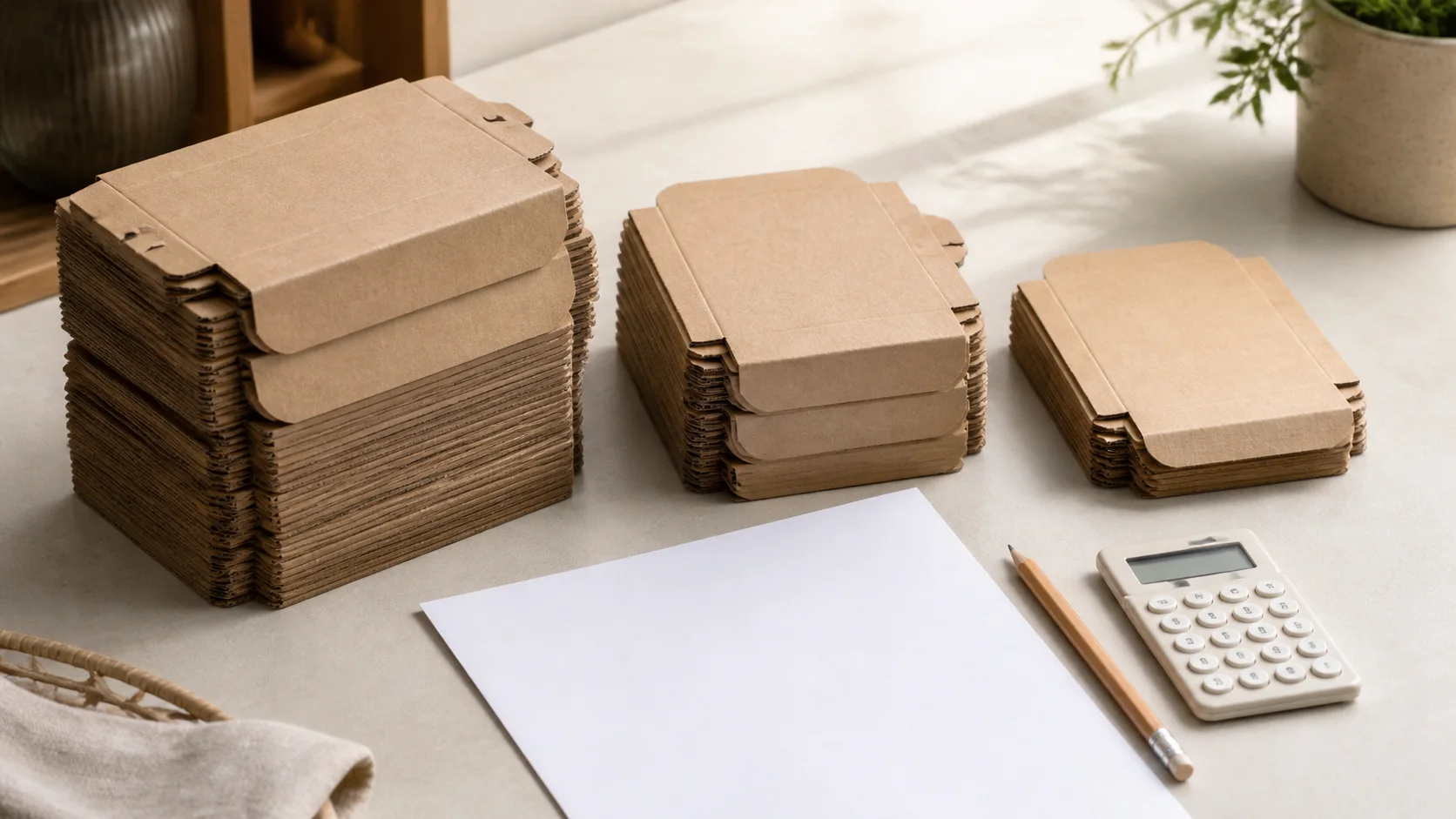
Start from consumption, not from the price break. Take your daily usage, multiply by the days you want covered, and add a margin for growth and waste rather than finding the quantity with the best unit price and hoping to use it.
A reasonable default for a stable, proven item is three to six months of stock. That is long enough to earn a meaningful price break and short enough that a menu change, a rebrand, or a rule change does not strand you. For a new item that has not been through a revision yet, order the smallest run you can and expect to change something.
Why Over-Ordering Costs More Than It Saves
Food boxes wholesale ordering differs sharply from other categories here, for four reasons.
Storage is genuinely scarce. Back-of-house space in a kitchen, bakery or cafe is small and expensive. Flat-packed cartons are compact but not free, and rigid or assembled formats consume real volume.
Kitchens are humid. Paperboard absorbs moisture and loses stiffness, and stock stored near a dish pit or an oven line degrades. A box that performed perfectly on delivery can arrive at the bench soft six months later.
Coatings and adhesives age. Barrier-coated stock and glued formats have their own storage life. Grease-resistant coatings and heat-seal layers do not stay at full performance indefinitely, so bulk food packaging with a functional barrier is a poorer candidate for very long holding than plain board is.
Menus change. Food businesses revise offerings far more often than product companies revise SKUs. A printed box naming a dish is a bet on that dish still being on the menu.
Check Labeling Claims Before a Long Print Run
Before committing to a long printed run, confirm that every recycling, compostability, material and food-contact statement remains accurate in each market where the packaging will be sold.
The FTC Green Guides advise marketers to qualify environmental claims and support them with reliable evidence. State requirements may impose additional limitations or effective dates.
Before approving the artwork, verify:
Which component each claim covers
The documented recycled-content percentage
Whether coatings, films or adhesives affect disposal
Whether specialist or industrial facilities are required
Whether the claim is accurate in every sales market
Whether any regulation changes during the planned stockholding period
Whether the supplier has substituted a material or formulation
For a new claim or a changing regulatory requirement, shorten the initial print run or remove the statement until it can be verified. A lower unit price does not compensate for a warehouse of packaging carrying obsolete or unsupported copy.
Our biodegradable food packaging claims guide covers the underlying terminology, evidence and market-specific limitations.
The One-Box, Many-Labels Approach

The most useful economy in food packaging wholesale is to stop buying a different printed box for every product.
Order a volume of one generic branded box, which gets you the wholesale price, then differentiate with a printed sleeve, a band, a sticker, or a label. Sleeves and labels have far lower minimums than cartons; they can be reprinted seasonally without new tooling, and they let you add or drop a menu item without stranding stock.
The same logic applies structurally. Standardize the external footprint across a range and vary only the insert, so one box format serves several products. It cuts tooling costs, simplifies storage, and makes reordering a single decision instead of six.
Food Packaging Wholesale or Low MOQ?
| Low MOQ Food Boxes | Food Packaging Wholesale | |
|---|---|---|
| Typical quantity | Small first runs | Bulk, repeat production |
| Unit cost | Higher | Lowest available |
| Print method | Usually digital | Usually offset |
| Best for | New items, seasonal, testing | Proven, high-turnover staples |
| Main risk | Margin pressure per unit | Menu or rule changes strand stock |
Most food businesses run both: wholesale quantities on core items that sell daily, and low MOQ food boxes for specials, seasonal ranges and anything still being tested.
What to Prepare Before Requesting a Quote
Food quotes need two things other categories do not. Supplying these upfront saves a round of questions:
- The product and its conditions. What goes in the box, whether contact is direct or indirect, the temperature range, and how long the food sits in it. This determines the material before anything else.
- Your consumption rate. Units per day or week, so pricing can be quoted at quantities you will actually use.
- Dimensions of the finished product. Measured, not estimated, and for decorated or filled items, measured at the largest realistic version.
- Two quantities. Always ask for pricing at two volumes so you can see where the break sits rather than guessing at it.
- Artwork status and any claims on it. Flag environmental or compliance claims early; they may need changing before print.
- Your deadline. Worked backward from launch, allowing time for a physical sample.
Repeat Orders: Check What Changed
Reorders feel like the easy part and are where food businesses get caught. Confirm two things every time.
First, that the material specification has not changed. Substitutions happen for supply reasons, and a substituted coating or board changes your food-contact documentation. Ask for confirmation that the compliance paperwork still covers the same application.
Second, that finish setup charges are not recurring in a way that makes the reorder disproportionately expensive. If they are, that is worth knowing before you specify a finish; you cannot afford to repeat packaging that visibly changes between runs, which undermines the consistency the spend was meant to buy.