
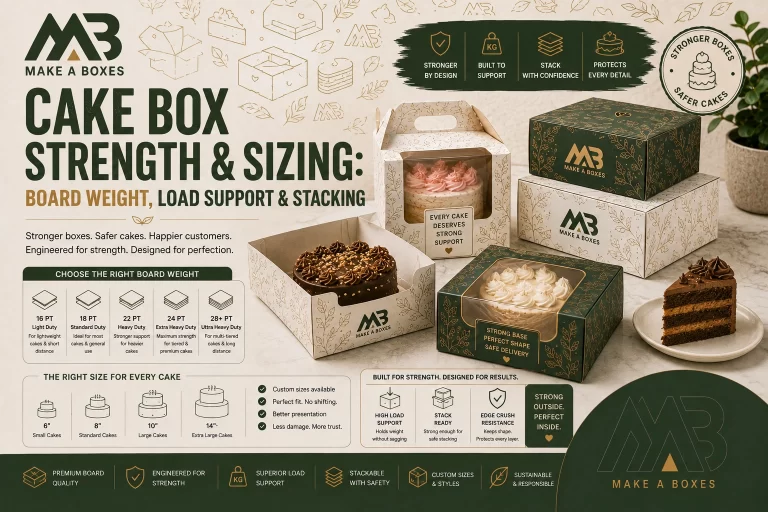
Why Do Cake Boxes Collapse?
Custom cake boxes fail in three ways, and each has a different cause.
Base sag. The bottom panel flexes downward under the cake’s weight, usually at the center. The cake tilts, decoration shifts, and on tiered cakes, the alignment goes. This is a board caliper and reinforcement problem.
Panel bow. The sidewalls flex outward, which lowers the effective height and brings the lid into contact with the top of the cake. This is usually an oversizing problem; walls with nothing to brace against bow more readily.
Closure release. The box opens in transit, generally at a corner and generally when carried at an angle. This is a closure design problem, not a board problem.
Collapse typically comes down to incorrect board thickness, oversized dimensions, or excess weight for the specification. Matching box strength to cake weight is the whole discipline, and it is not something you can judge by looking at a flat sample.
Board Weight: What 16pt to 24pt Actually Means
Paperboard caliper is measured in points, with one point equal to one-thousandth of an inch. Caliper influences rigidity, but it is not a universal load rating.
Cake weight, footprint, box dimensions, grain direction, base construction, closure design, refrigeration and stacking conditions all affect performance. A wide cake can place more stress on an unsupported base than a heavier cake with a smaller footprint.
Use the available caliper range as a starting point, then validate the selected construction with a filled sample. Do not promise that a particular board thickness will carry a specific weight unless the complete box-and-cake configuration has been tested.
SBS or Kraft?
SBS and kraft paperboard can both be used in food packaging, but neither should be described as automatically food-grade in every configuration.
Food-contact suitability depends on the board, recycled-fiber content, coatings, inks, adhesives, liners and intended conditions of use. The FDA’s guidance on food-contact-material components explains why every relevant component must have an appropriate regulatory basis.
SBS provides a clean white printing surface and accurate color reproduction. Kraft creates a natural brown appearance and can hide minor handling marks, but artwork must be adjusted for the darker substrate. Choose between them based on appearance, structural testing and documented suitability for the intended application.
Load Support and the Reinforced Base
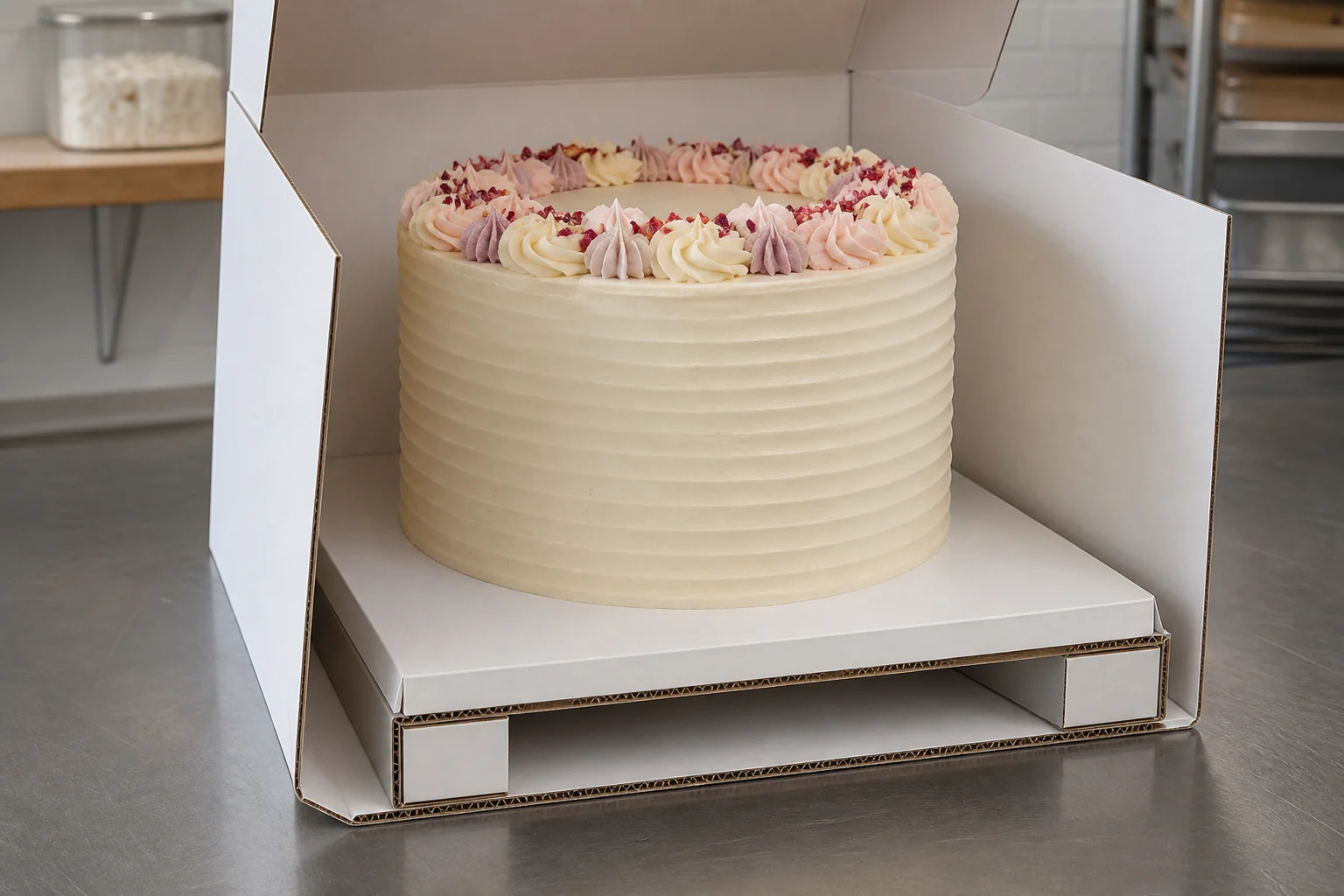
A reinforced base distributes the cake’s weight across a larger area and reduces the stress concentrated at the center of an unsupported panel.
Base construction should be evaluated together with the cake board. The cake board carries the immediate product load, while the carton contains and protects the complete assembly. Neither component should be treated as a substitute for the other.
When comparing specifications, ask for:
Board material and caliper
Base construction
Internal dimensions
Grain direction where relevant
Intended cake-board dimensions
Tested packed weight
Stacking conditions
Refrigeration or condensation exposure
Test the final configuration with the actual cake weight and footprint. A successful test for one size should not automatically be applied to a wider or taller format.
Cake Box Sizes: How to Measure
Cake box sizes are measured around the cake board, not the cake. This is the single most common sizing error in the category.
Footprint
Take the diameter or width of the cake board the cake sits on, then add clearance so the board slides in without forcing. Too tight and the board catches and drags decoration on the way in; too loose and the whole assembly slides in transit. The board is the thing being contained; the cake is just what sits on it.
Height and Clearance
Measure from the base of the cake board to the highest point of the decoration, then add clearance so nothing contacts the lid. Toppers, piped work, drips and fresh flowers all sit above the cake body, and buttercream in particular marks on the lightest contact.
Tall Cake Boxes
Layer cakes, tiered cakes and anything with a topper need tall cake boxes rather than a standard depth with a taller lid. Height changes the structural problem: taller sidewalls bow more readily under the same load, so tall formats generally need a heavier caliper than a low-profile box of the same footprint. Specify the height first, then reconsider the board.
Cake Board and Box: Why You Need Both
A cake box is not a substitute for a cake board, and boxes are not designed to be one. The board provides the rigid surface the cake sits on, keeps it level, allows it to be lifted without being touched, and separates the cake from the box surface for hygiene. Even a well-specified box needs cakes placed on boards or liners for stability and hygiene.
Specifying the two together avoids the common mismatch where a board arrives slightly too large for the box it was bought for. Decide the board size from the cake, then the box from the board, in that order.
Closures: Why Friction-Lock Matters
A cake box that opens has failed regardless of how strong the board is. Friction-lock closures hold by tension between panels rather than relying on the lid resting in place, which is what keeps a box shut when it is carried by one hand at an angle across a car park.
Fortified edges do the related job of preventing accidental opening under handling. Neither adds much to unit cost, and both are worth specifying explicitly rather than assuming.
Stacking, Assembly and Tolerance
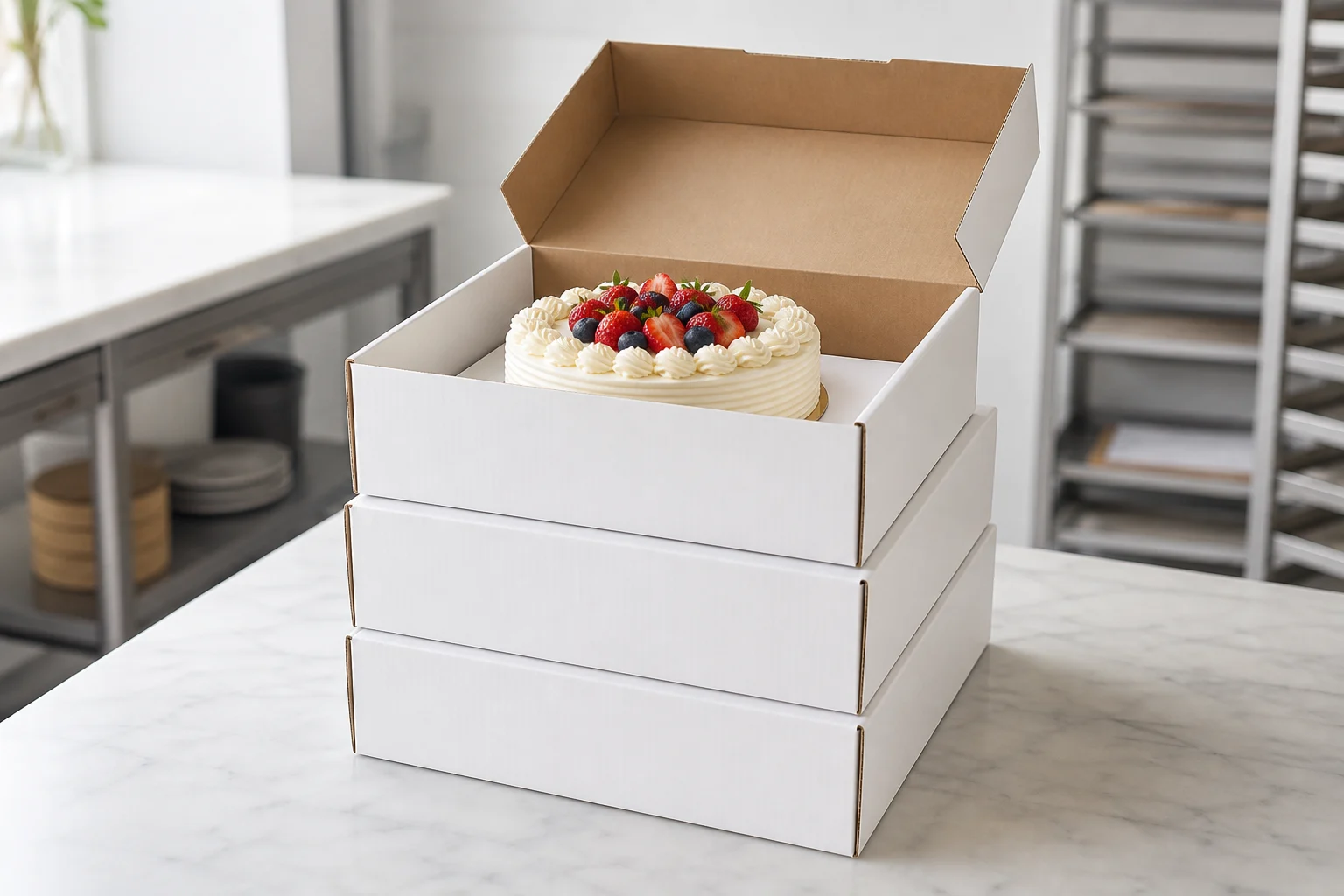
Dimensional consistency affects panel alignment, closure performance and assembly speed. Ask the supplier to state the manufacturing tolerance included in the approved specification and verify it against production samples. Do not publish a universal die-cut tolerance unless that figure is documented, contractually controlled and supported by current quality-assurance records.
Dimensional tolerance is the specification nobody asks about, and everybody notices. We hold die-cut variance to roughly ±1.5 mm using CNC-controlled cutting, which is what allows panels to align on the first fold. A box cut loosely takes longer to assemble, and a few seconds per box across a Saturday morning is a real labor cost in a bakery filling dozens of orders before opening.
Cake Boxes with Lid: One-Piece or Two-Piece?
One-piece cake boxes with lid attached fold from a single blank, assemble faster, and cost less. They are the sensible default for everyday retail, and the lid hinges back out of the way during filling.
Two-piece boxes, a separate lid lifting off a base, cost more and assemble slower, but they lift straight up rather than hinging, which means nothing sweeps across the top of the cake as it opens. For tall decorated work, and for gifting where the reveal matters, that is worth paying for. Delicate toppers are the clearest case.
Windows, Grease and Refrigeration
Custom cake boxes with a window show the product before purchase, which drives counter sales, but on a load-bearing box a large cut-out reduces panel rigidity. If you want a window on a cake box, expect to move up a caliper to compensate.
Grease is less of an issue for cakes than for pastries, but butter-rich sponges and ganache do migrate, and the cake board takes most of that contact rather than the box. Refrigeration is the bigger consideration: a cake stored cold and then moved to ambient collects condensation, and paperboard absorbs moisture and loses stiffness as it does. If your cakes are refrigerated before collection, factor that into the caliper decision rather than specifying for a dry bench.