
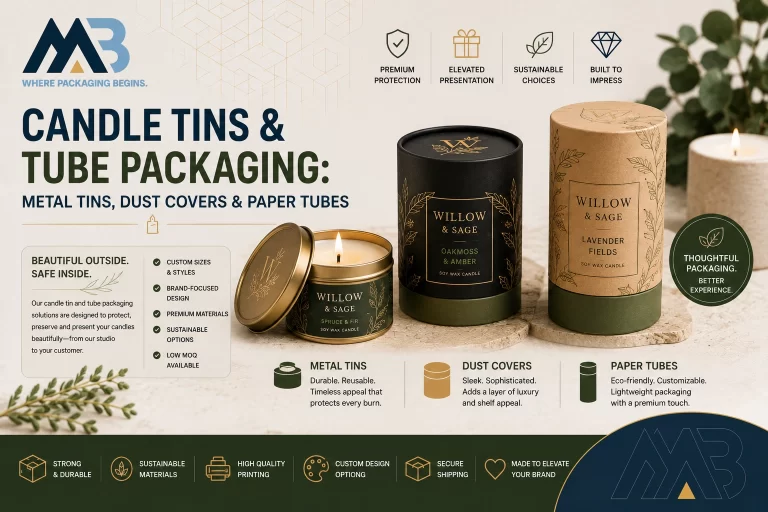
Why Choose Tins or Tubes Over Glass?
The short answer: shatter risk, weight, and shipping cost. A metal tin arrives intact from handling that would destroy a jar, which removes the single largest cause of replacement orders in this category. Tins and tubes are also lighter, and because carriers bill on dimensional weight as well as actual weight, a lighter vessel in a smaller outer compounds into a real saving across a year of orders.
There are genuine trade-offs. Metal conducts heat, so a tin left in direct sun gets hot faster than glass and the wax softens sooner. Tins cannot show the wax color, which matters in a category where the product’s appearance does part of the selling. And a tin does not have the perceived value of heavy glass, which is why premium tin ranges lean on the outer packaging to carry the positioning that the vessel cannot.
Paper tubes occupy a different position again. A tube is not a vessel; it is an outer that wraps a jar or a tin, adding a full printable surface, a cylindrical silhouette that stands out against a shelf of rectangles, and a genuine reveal when the customer slides the product out.
Candle Tins: Sizes and Materials
Our candle tins run from 1 oz to 12 oz, which covers mini sample sizes through to full retail candles. That range covers most needs, and buyers ordering candle tins wholesale usually start at the small end, where tins are hardest to beat: a 1–2 oz sample in glass costs more to make and more to protect than the sample itself is worth, while the same size in metal ships in a padded envelope.
Aluminum or Tinplate?
Both are used across the range. Aluminum is lighter, does not rust, and takes a brushed or matte finish cleanly. Tinplate is more rigid, which matters at larger diameters where a thin wall can dent under a lid press or in transit. For most brands, the decision comes down to finish and feel rather than performance; handle samples of both before committing, because the difference is obvious in the hand and invisible in a spec sheet.
One practical note on ordering. Candle tins bulk pricing improves sharply with quantity because tooling is shared across the run, so if you are testing two diameters, it is usually cheaper to order both in one order than to run them separately. Confirm too whether you are quoted candle tins with lids as a single unit or as two components; suppliers differ, and it changes the comparison.
Do Tins Still Need a Box?
Usually, yes, but for different reasons than glass does. A tin does not need structural protection; it needs a branding surface and a tamper-evident closure. A bare tin gives you a lid to print on and nothing else, which is not enough to compete on a shelf. Candle tin boxes solve that by wrapping the vessel in a printable outer without adding the board weight a glass jar would require.
Candle Tin Boxes: Which Structures Work
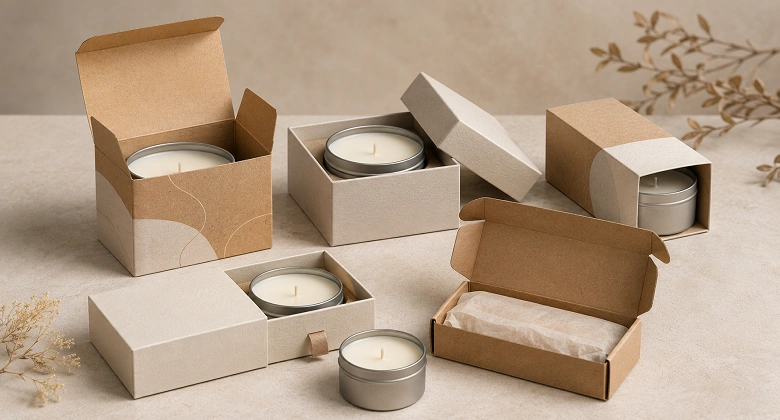
Because the vessel is unbreakable, boxes for candle tins can be chosen for presentation rather than protection, which opens up structures that would be irresponsible around glass.
- Tuck end carton. Cheapest, ships flat, full print surface. The sensible default for retail tin ranges.
- Wraps the tin without enclosing it, so the metal stays visible. Lowest material cost of any printed option.
- Two-piece lid and base. Premium presentation for gift positioning, where the tin alone would read as inexpensive.
- Window box. Shows the lid finish. Useful when the tin itself is the design feature.
Multi-tin sets are where candle tin boxes earn their cost most clearly. A three- or four-tin sampler needs a compartmented insert to stop the tins sliding and scuffing each other’s finish; brushed and matte metal marks easily, and a scuffed lid reads as a defect even though the candle is untouched.
Candle Tube Packaging
A paper tube is a rigid cylinder with a lift-off cap, sized to slide over a jar or a tin. Our candle tube packaging works to a typical inner size of 70 mm diameter by 120 mm high and fits vessels from 2 oz to 16 oz, adjustable to your candle.
How Do You Size a Tube to a Vessel?
Measure the widest outer diameter of the vessel, usually the rim on a tapered jar, or the lid seam on a tin, and the total height including the lid. Add a small clearance so the product slides in without binding, but not so much that it rattles. A tube that is too generous defeats the point, because the vessel then moves inside a rigid cylinder with nothing to stop it.
Kraft or Black Paper Candle Tubes?
A kraft paper candle tube reads as natural and recycled, which suits soy and botanical positioning, and the brown tone works with minimal single-color printing. A black paper candle tube reads as the opposite: modern, high-end, and a strong ground for metallic foil, white ink, or debossed logos, with a matte finish that resists fingerprints better than gloss. Both are available in kraft paper, rigid cardboard, or premium paperboard depending on how substantial you want the tube to feel.
When Does a Tube Beat a Carton?
When the silhouette matters, when the vessel is round, and a rectangular carton would waste internal volume, and when you want the customer to keep the packaging. Tubes get reused far more often than folding cartons, which is a quiet brand-presence advantage. Paper candle tubes are weaker on stacking and on flat shelf facings, so they suit gift and direct-to-consumer selling better than dense retail shelving.
Candle Dust Covers
A dust cover is a lightweight paper sleeve or cap that sits over the candle to keep the wax surface clean. It is the minimum viable packaging in this category; it protects the product without pretending to be a box.
The problem it solves is specific. An uncovered candle collects dust on the wax surface, which is visible, looks like age, and is the first thing a customer sees. Covers also reduce air exposure at the surface, which helps a fragrance hold up over a long retail dwell time. Our candle dust covers are die-cut from kraft or linen-textured recycled paper in a heavy GSM, sized from small votives up to 16 oz jars.
Two uses are worth planning for. As a retail layer, a printed cover turns a bare vessel into a branded product at a fraction of the cost of a carton. As a component inside a box, it keeps the wax clean during assembly and transit and gives the customer a second layer to open.
Tin, Tube or Carton: Which Should You Choose?
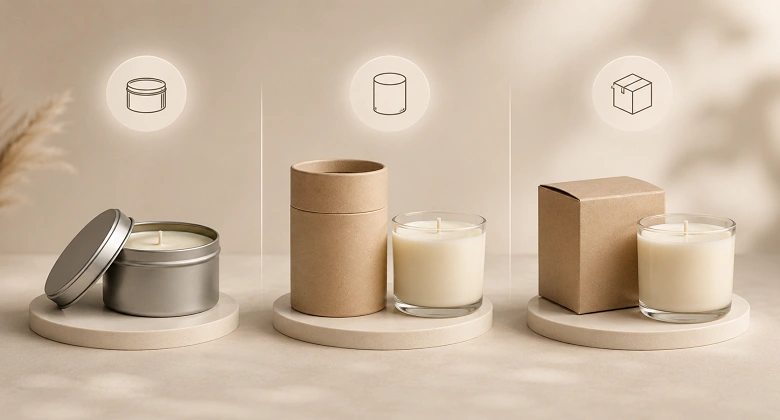
The honest answer depends on where you sell and what your vessel already is. This table compares the four options on the criteria that actually differ:
Common Mistakes With Tins and Tubes
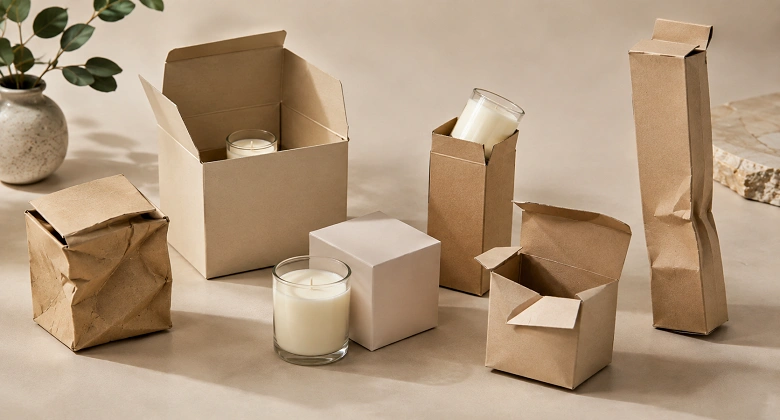
- Assuming a tin needs no packaging. It needs a branding surface and a closure even though it needs no protection.
- Sizing a tube to the jar body. Measure the widest point and the total height including the lid.
- Leaving tins loose in multi-packs. Brushed and matte finishes scuff, and a marked lid reads as a fault.
- Ignoring heat with metal. Tins reach ambient temperature faster than glass; summer transit needs the same care.
- Blanket recyclability claims. Foiled and laminated tubes are composites. Describe components separately.
Final Thoughts
Tins and tubes are usually treated as the budget corner of candle packaging, and that framing costs brands money. A tin removes your breakage rate, and an outer box gives candle tins the retail presence the bare vessel lacks. A tube gives you a shape nobody else on the shelf has. A dust cover turns a bare vessel into a branded product for pennies. None of those are compromises; they are different answers to the question of what the packaging is actually for.
If you are currently all-glass, the useful experiment is a single sample size in tin. It costs little to trial, it tells you quickly whether your customers care about the vessel or the fragrance, and it is the cheapest way to find out whether your breakage rate is a packaging problem or a format one.