

Why Candles Are Difficult to Ship
Candles combine two properties that rarely appear together in a package: they are dense for their size, and they are brittle. A filled glass jar carries most of its weight low and rigid, so when a box is dropped, the momentum has nowhere to go except into the vessel or into whatever is holding it.
Then there is heat. Wax is the only common e-commerce product that changes state at temperatures a delivery vehicle reaches routinely in summer. Soy and coconut blends soften well below the inside temperature of a van parked in the sun, and wax that softens and resets can pull away from the glass, pool unevenly, or sink around the wick. The product is not damaged in any structural sense, but it looks wrong, and customers report it as a fault.
The third factor is volume. A candle brand that ships one unit at a time has a simpler problem than one shipping three-jar gift sets, because the moment two glass vessels travel in the same box, the dominant risk stops being the box wall and becomes the other jar.
Choosing Candle Shipping Boxes
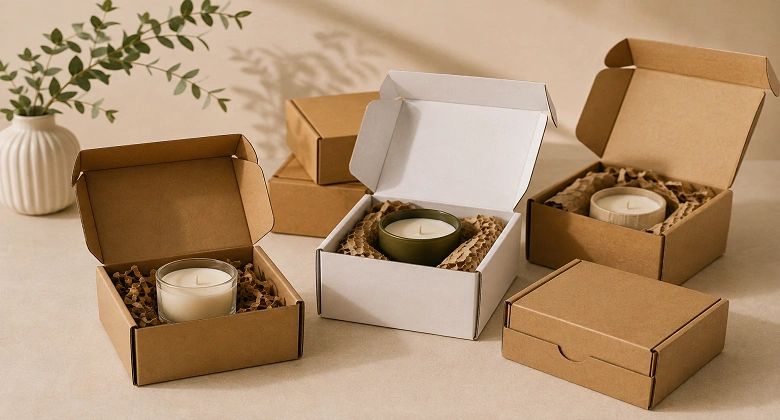
Corrugated Grade
Single-wall E-flute is the entry point for candle shipping boxes holding one standard jar: thin enough to print reasonably well, with fluting that compresses and rebounds under impact. B-flute gives thicker cushioning for heavier or multi-unit orders. Double-wall becomes worth its cost once a package passes roughly three filled jars, or when a single vessel is unusually heavy.
Folding cartons made from SBS or kraft paperboard are not shipping boxes, regardless of caliper. They are presentation layers. If a printed retail carton is going into the post, it needs a corrugated outer around it.
Mailer or Regular Slotted Carton
A die-cut mailer opens flat, self-locks, and needs one strip of tape faster to pack and better for unboxing, which matters for direct-to-consumer orders. A regular slotted carton is cheaper per unit and stronger in a stack, which suits wholesale shipments and larger multi-unit orders. Most brands selling through both channels keep candle boxes for shipping in both formats.
Sizing to the Insert, Not the Candle
This is the most common sizing error. Candle shipping boxes should be dimensioned around the loaded assembly vessel, plus retail carton, plus insert, with enough clearance that no part of the glass sits against the outer wall. Roughly half an inch of standoff on every face is a workable target; less than that and an impact absorbed by the outer surface transfers straight into the vessel.
Inserts, Cradles and Void Fill
The insert is what actually protects the candle. Its purpose is not to occupy empty space but to immobilize the vessel so that box and product move as one object. A jar that can travel even a millimeter inside its packaging will do so thousands of times across a long-haul route.
Die-cut corrugated cradles are the reliable default: they hold the vessel centered, absorb shock through the fluting, and cost little at volume. Molded foam gives more protection and a more controlled reveal for premium or multi-piece sets. A candle shipping box with insert cut to the same specification as the outer box removes the guesswork of matching two separately sourced components.
What to avoid is more instructive. Loose fill migrates during transit and leaves the vessel unsupported by the time it arrives. Bubble wrap alone controls surface abrasion but not position, so the jar still travels. Crumpled paper compresses and stays compressed. All three feel protective when you pack the package, and none of them hold the product in place once it has been handled.
A Repeatable Packing Method

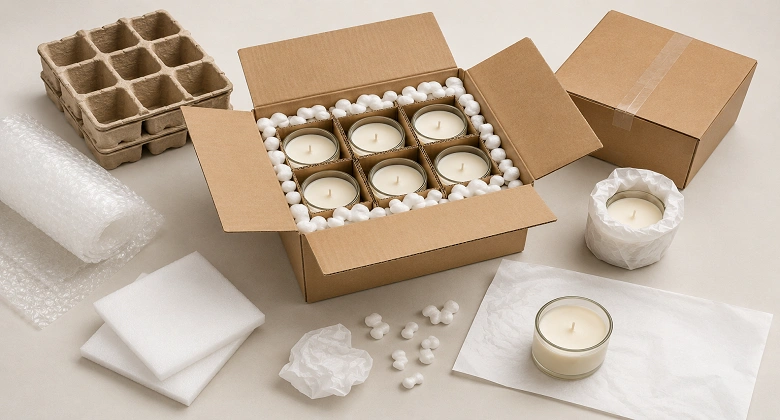
Consistency matters more than any single technique, because damage usually traces to a package packed differently from the rest. A workable sequence for boxes to ship candles:
- Seat the vessel in its retail carton first, so the presentation layer is protected before anything else happens.
- Place the carton into the die-cut cradle, checking it sits fully home rather than resting on a fold.
- Load into the outer box and confirm no face of the product touches an outer wall.
- Fill any residual gap deliberately with cut corrugated pads rather than loose material.
- Seal with the H-taping method — center seam plus both edge seams, top and bottom.
- Shake the sealed package. Anything audible means the pack is not finished.
Shipping Multiple Candles
Once candle shipping boxes hold more than one glass vessel, glass-to-glass contact becomes the failure mode to design against. Jars strike each other far harder than they strike a board wall, and a divider between vessels is not optional; a cradle that surrounds each jar individually is better still.
Gift sets add a second problem: accessories. A matchbox, wick trimmer or ceramic lid loose in the same cavity becomes a projectile against the glass. Compartment every component. Presentation considerations for retail and gift formats are covered separately in our guide to candle display, gift and subscription boxes.
Hot and Cold Weather Shipping
Heat is the risk you cannot pack your way out of entirely, but you can reduce it. Reflective or insulated liners slow the rate at which a package reaches ambient temperature, which is often enough for a two-day service even in summer. Shorter transit times help more than any material upgrading service level in peak heat; it is frequently cheaper than replacing softened stock.
Cold matters less but is nothing: some waxes become brittle and can crack or frost at low temperatures, which is cosmetic rather than functional but still generates complaints. The practical answer in both directions is to set customer expectations in advance. A short seasonal note at checkout costs nothing and converts a support ticket into an informed purchase.
Dimensional Weight and Cost Control
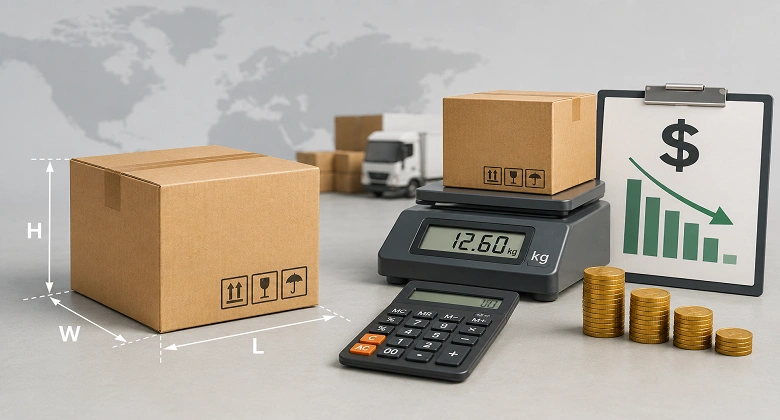
Protection and postage pull in opposite directions. Carriers bill on dimensional weight, so every extra inch of standoff you add to a package raises the shipping cost of every order you send, and past a point, a well-protected box costs more to ship than the breakage it prevents.
The way through is to size candle shipping packaging tightly around the insert rather than adding margin everywhere. A cradle that holds the vessel securely with half an inch of clearance protects better than a larger box padded with void fill, and bills less. Work out your true cost per delivered unit: box, insert, postage, and the replacement rate rather than optimizing any one line in isolation.