
How to Measure a Candle for Its Box
Every decision about candle box styles and sizes comes down to three numbers and one judgement. The numbers are the candle’s maximum width or diameter, its total height, and its weight when finished. The judgement is how much clearance to allow around it.
Measure at the widest point rather than the nominal size. Molded candles carry real tolerance, hand-poured ones more so, and a batch that varies by a millimeter will jam in a box cut to the average. If the candle has a decorative top, a wick tab that sits proud, or a dust cover, all of it counts toward total height.
How Much Clearance to Allow
For retail boxes that sit on a shelf, 1–2 mm around the candle is enough; the product should not rattle, but it should still drop in cleanly on a packing line. For anything shipped, the internal fitment needs to hold the candle centered with real standoff between the wax and the outer wall. Glass vessels have their own requirements, covered in detail in our guide to candle jar packaging.
Under-tolerancing is the more expensive mistake. A box 2 mm too large produces a slightly loose pack; a box 2 mm too small produces a production run you cannot use.
Candle Box Sizes by Candle Type
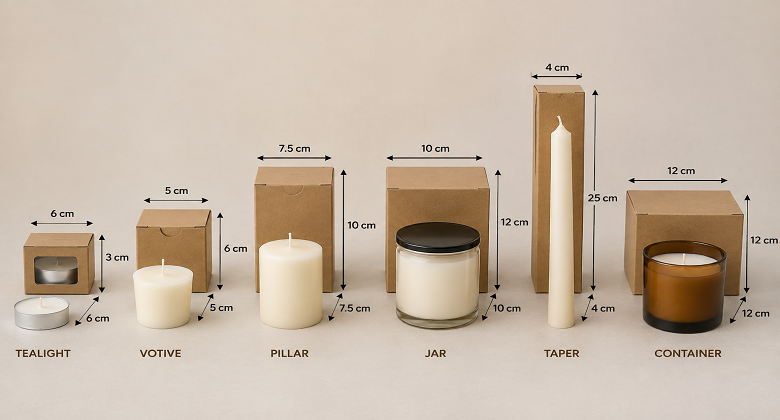
The table below gives the typical inner dimensions we work to for each format. All are adjustable; these are starting points for a conversation about your specific candle, not fixed stock sizes.
Taper Candle Boxes
Tapers present a problem no other candle format does: length without width. A 12-inch candle in a slim carton has almost no structural support along its span, so the box bows in storage and the candle bends with it. Warm conditions make it worse, and a bent taper is unsellable even though nothing is broken.
The answer is board stiffness rather than thickness for its own sake. Our taper candle boxes are built from SBS paperboard or rigid chipboard specifically to hold tapers straight through transport, and they cover classic lengths from 8 to 12 inches. Where a set contains multiple tapers, an internal divider stops them rubbing against each other and scuffing the wax surface.
Style options that suit the format: tuck top for straightforward retail, two-piece for gift positioning, and sliding drawer where the reveal matters. All three work at this proportion; a standard mailer does not, because the flap geometry fights the length.
Votive Candle Boxes
Votives are the most forgiving format to package. They are small, roughly as wide as they are tall, and light enough that board caliper is rarely the constraint. The typical inner size we work to is 55 × 55 × 65 mm, which suits candles in the 1.5–2.5 oz range, and it adjusts to the candle rather than the other way round.
Because votives sell heavily as gifts and in multiples, the packaging decision is usually about presentation rather than protection. Window cutouts perform well here; the candle’s color is a large part of what sells it, and a small format gives you little printed surface to work with. Our votive candle boxes cover kraft through to luxury finishes on the same footprint.
Pillar Candle Boxes
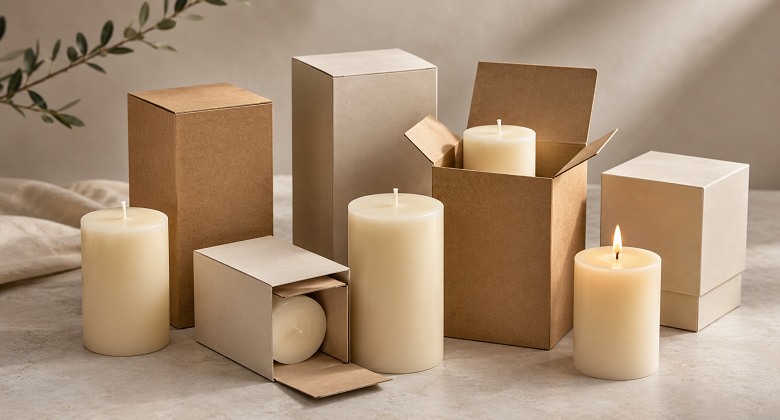
Pillars are where weight starts to matter. A large decorative pillar is dense, and a carton specified for a votive will splay at the base under it. The typical inner size we work to is 75 × 75 × 150 mm, adjustable across slim styles up to large decorative pillars.
Two structural details are worth specifying deliberately. Reinforced panels and interlocking flaps hold shape under compression, which matters if boxes are stacked in a stockroom. And a die-cut base fitment stops a heavy candle sliding within the box, which is what causes corner damage in transit. Our pillar candle boxes are available in kraft, corrugated, rigid board or coated cardstock depending on where the weight sits.
Tealight Candle Boxes
Tealights are almost never sold singly, so tealight boxes are sized around the pack rather than the candle. A standard cup is small and shallow, and the box has to hold a set of them without letting individual cups shift, tip, or stack against each other.
Compartmented inserts or multi-cavity die-cuts solve this. They keep each cup seated, they make the pack look deliberate when opened, and they prevent the rattle that makes a small pack feel cheap. Window cutouts work particularly well on tealight candle boxes, where showing wax color and texture does more selling than the printed panel can at that size.
Two Piece Candle Boxes
2 piece candle boxes are a separate lid over a base, and the format is a structure rather than a candle type. It works for jars, tins, pillars, and gift sets alike. It is the strongest option for heavy candles because rigid walls do not flex, and it gives the most controlled unboxing moment of any style.
The trade-offs are cost and logistics. Two-piece boxes do not ship flat, so inbound freight and storage cost more, and the unit price sits above any folding carton. Where they earn that back is in gift and premium positioning, where the box is part of what the customer is paying for. Our 2-piece candle boxes take foam, cardboard or molded pulp inserts to keep vessels centered. If you are weighing this against other premium structures, our guide to choosing luxury candle packaging compares finishes and cost.
Candle Box Styles Explained
Format determines size; candle box styles determine how the box behaves. The main candle box styles, and what each is actually good at:
- Tuck end carton. Ships flat, assembles fast, prints well. The default for retail across most formats.
- Two-piece lid and base. Strongest and most premium. Does not ship flat.
- Sleeve and tray. Splits artwork from structure, useful for seasonal refreshes on a fixed candle.
- Sliding drawer. Strong reveal, good for tapers and gift sets, slower to pack.
- Mailer with insert. Built for transit rather than shelves. Limited print detail.
- Window box. Shows the product. Back the window with film unless the candle is fully enclosed elsewhere.
Sizing for Multi-Candle and Gift Sets
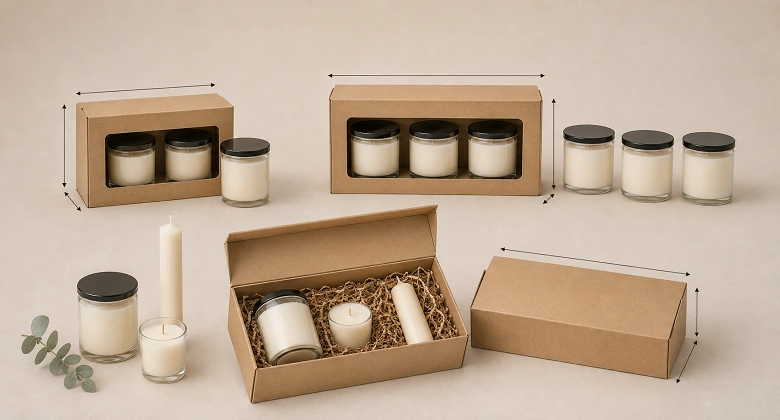
Sets are where candle box sizes stop being arithmetic. Adding the individual footprints together gives a box that is technically large enough and practically unusable, because it ignores the divider walls, the insert thickness, and the finger room a customer needs to lift the first candle out.
Work outward instead. Start from the internal layout: how many candles, in what arrangement, with what between them, then add the insert material, then the clearance, then the walls. A three-votive set laid in a row needs two dividers and a lift-out allowance at one end; the same three in a triangle need a different insert entirely and a squarer box.
Mixed sets compound this. A pillar packed alongside two tealights has one heavy component and two light ones, and the insert has to stop the heavy item moving into the light ones. Specify the compartment for the heaviest piece first and build the rest of the layout around it.
Stock Sizes or Custom Dimensions?
Stock candle box sizes are cheaper and faster, and for a candle close to a standard footprint they are often the sensible answer. The cost shows up as fit: a candle sitting in a box 5 mm too large in every direction looks like it came from someone else’s product line, and it moves in transit.
Custom candle box sizes are worth it when the candle is unusual in proportion, when the box is part of the brand story, or when you are packing multiples and the internal layout has to be designed rather than approximated. In practice, most brands run stock for high-volume basics and custom for the ranges they want remembered.
Materials by Candle Format
Board choice follows weight and route to market rather than candle box styles alone. Lightweight formats votives, tealights, tapers sit comfortably on SBS paperboard or kraft in a standard caliper, where print quality and stiffness matter more than crush resistance. Pillars and multi-candle gift sets move up to corrugated or rigid board, where compression strength does the work.
Kraft is worth considering beyond its eco positioning: it hides handling marks far better than bleached white, which matters on formats that get picked up and put down repeatedly on a retail shelf.