
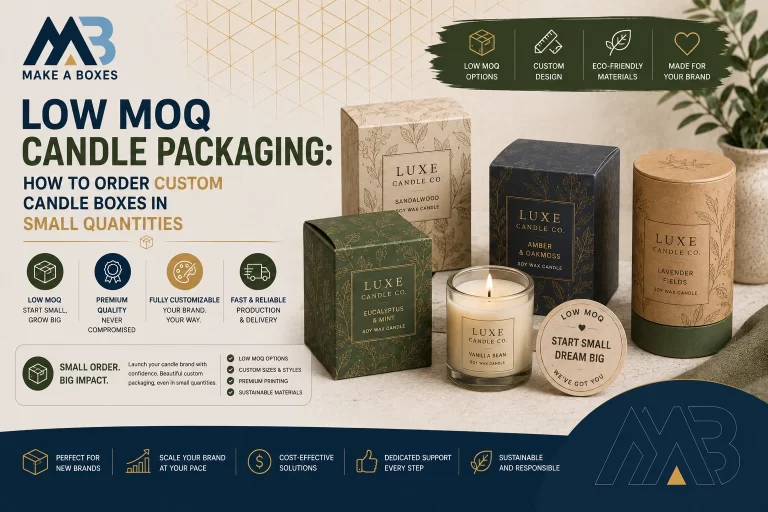
What Does MOQ Mean in Candle Packaging?
MOQ stands for minimum order quantity: the smallest number of units a supplier will produce in a single run, and the figure that separates candle packaging wholesale buying from small-batch ordering. It is not an arbitrary gatekeeping figure. It reflects the point at which a job covers the fixed costs of setting it up, which exist whether you order fifty boxes or fifty thousand.
That distinction matters because it tells you what to negotiate. You cannot argue a supplier out of their setup costs, but you can often change the specification so those costs are lower, and that is usually where a workable small order comes from.
Why Do Suppliers Set Minimums?
Setup Costs Are Fixed
Every custom box requires a dieline to be drawn, a cutting die to be made, artwork to be prepared for press, and the press itself to be set up and color-matched. That work costs the same for a run of 100 as for a run of 10,000. Spread across 10,000 units, it disappears into the unit price; spread across 100, it dominates it.
Print Method Changes the Math
Offset printing produces the best color fidelity and the lowest cost per unit at volume, but it requires printing plates made for each job, a real fixed cost. Digital printing skips the plates entirely, which makes short runs viable, at a higher cost per unit and with some limits on finishes and special colors.
This is the single most useful thing to understand about candle packaging wholesale pricing. If a quote for a small quantity looks impossible, asking whether the job can run digitally instead of offset often changes the answer more than negotiating on price ever will.
Why Low MOQ Matters for a New Candle Brand

The obvious benefit is cash: you are not tying up working capital in inventory before you know what sells. The less obvious benefits matter more over time.
A small run lets you test a design in the market and revise it. Almost every brand changes its packaging after seeing it in customers’ hands: a finish that looked right on screen reads cheap in person, a size runs tight, a color shifts on kraft. Discovering that across 200 boxes is a lesson; discovering it across 5,000 is a write-off.
Small runs also let you carry more SKUs. A brand with four fragrances and a low minimum can give each one its own box; the same brand at a high minimum runs one generic design and loses the shelf differentiation that made the range worth having.
Candle Packaging Wholesale or Low MOQ: Which Do You Need?
These are two different buying modes, and brands often ask for one when they need the other.
Most established brands end up running both: candle packaging wholesale quantities on the core range where demand is predictable, and small runs for new fragrances, limited editions, and seasonal boxes that have not earned a bulk commitment yet.
What to Prepare Before Requesting a Quote
A vague enquiry produces a vague quote. Having these six things ready shortens the process considerably and produces a number you can actually rely on:
- Candle dimensions. Width or diameter at the widest point, total height including the lid, and finished weight.
- Box style. Tuck end, two-piece, sleeve, mailer, tube. If you are unsure, describe how the box will be used instead.
- Material and finish. Kraft, SBS, corrugated or rigid, plus matte, gloss, soft-touch or foil.
- Quantity and a second quantity. Ask for pricing at two volumes so you can see where the price break sits.
- Artwork status. Print-ready files, rough concept, or nothing yet. All three are workable; they just change the timeline.
- Work backwards from your launch, not forwards from your order date.
How Does the Ordering Process Work?
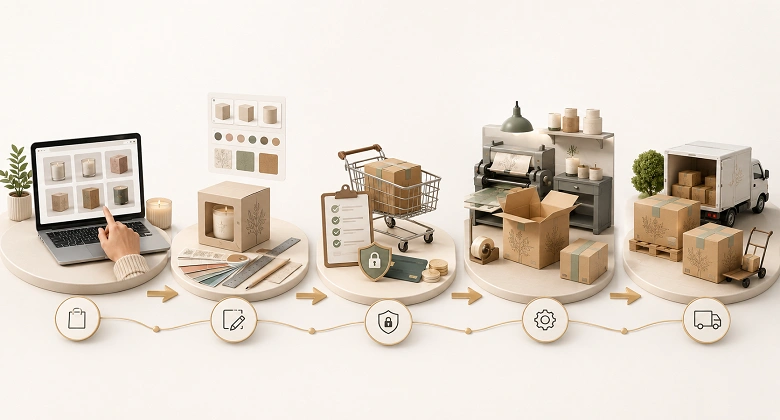
The sequence is broadly the same across suppliers, and knowing it helps you see where delays actually come from:
- You supply dimensions and requirements; the supplier confirms what is feasible and quotes it.
- A flat template is produced for your exact box. Your designer lays artwork onto this, not onto a guess.
- A digital proof confirms layout and content. A physical sample confirms everything a screen cannot.
- Printing, die-cutting, finishing and gluing.
- Flat-packed for folding cartons; assembled for rigid formats, which affects shipping cost and storage.
The step most often skipped is the physical sample, and it is the one that catches the expensive mistakes. Pack a real candle into a real sample before approving a run; fit problems, color shifts, and finish disappointments all show up there and nowhere earlier.
What Drives Cost in a Small Run?
Four things move the price more than quantity does at low volumes, and none of them disappear when you move up to candle packaging wholesale runs. Special colors: Pantone matching costs more than CMYK, and each additional special color compounds it. Finishes: foil stamping, embossing, and spot UV each add a pass through a machine, and each pass carries its own setup. Structure: rigid two-piece boxes cost several times a folding carton and do not ship flat, so freight rises too. And unusual dimensions: a size that nests badly on a press sheet wastes board on every single unit.
If a quote comes back above budget, those four are where to look first. Dropping one finish or shifting a Pantone to process color will usually move the number more than trimming the quantity will, and unlike cutting the quantity, it does not leave you short of stock.
When Should You Scale Up?
The signal is not a revenue milestone; it is stability. Once a design has been through at least one revision, sells at a predictable rate, and is not about to change for a rebrand or a new vessel, ordering candle boxes wholesale turns the per-unit saving into real money rather than a gamble.
Two cautions. Storage is a genuine cost; flat cartons are compact but not free, and rigid boxes take serious space. And packaging ages: a large run of seasonal or dated design can outlive its relevance before it outlives its shelf life. Ordering the quantity you will use in a defined period beats ordering the quantity with the best headline unit price.
Common Mistakes When Ordering Small Quantities
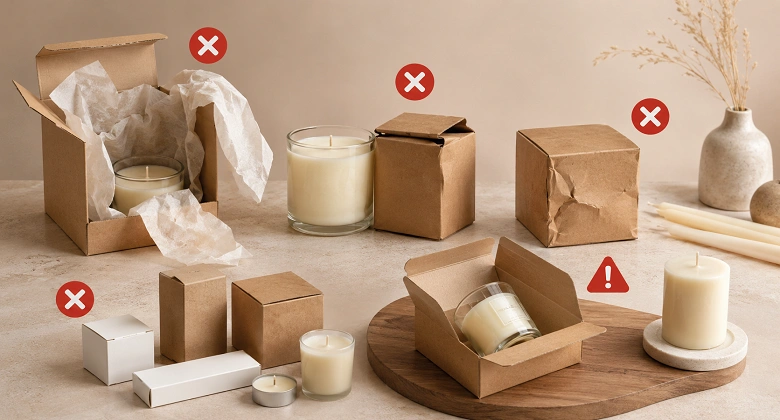
- Ordering before the vessel is finalized. A box is cut to a specific candle. Change the jar and the boxes are scrap.
- Approving a digital proof only. Screens do not show board texture, finish, or true color on kraft.
- Specifying finishes you cannot afford to repeat. If the reorder has to drop the foil, your packaging changes visibly between runs.
- Buying to hit a price break. A lower unit price on candle packaging supplies wholesale that you cannot sell through is not a saving.
- Ignoring how it ships. Retail boxes still need transit protection, covered in our guide to shipping.
- Leaving no timeline margin. Proofing and revisions take longer than production on a first order.
Final Thoughts
Low minimum order candle boxes are not a compromised version of proper packaging. They are how a brand gets to proper packaging without betting the business on an untested design. Order what you can sell, learn what the market tells you, revise, then scale the version that works.
If you are choosing formats before you order, our guides to shipping candles safely and to candle tins and tube packaging cover the two decisions that most often change a specification after the first run. You can also browse formats and options on our custom candle boxes page.