
How Do You Choose Bakery Box Sizes?
Bakery box sizes come down to three measurements and one principle. The measurements are the footprint of the finished item at its widest, the height including any decoration, and the number of pieces per box. The principle is snug fit: the product should not be able to move.
Measure the Decorated Product, Not the Base
A cupcake is not the width of its case; it is the width of its frosting. A donut is not the diameter of the dough; it is the diameter after glaze spreads. Decorated products grow between the oven and the counter, and they vary between bakers on the same shift. Measure several finished examples and size to the largest realistic one.
Oversizing Causes More Damage Than Undersizing
Bakery box sizes work the reverse of most packaging categories, where a slightly large box is merely inefficient. In bakery, empty space is the damage mechanism. A cupcake with a centimeter of room will tip; a cookie with room to slide will chip its edge against its neighbor. Snug-fit boxes reduce movement, which is why they protect better than a larger box with padding.
Height Is the Measurement People Forget
Frosting, glaze, ganache and piped decoration all sit above the product, and bakery box sizes have to clear them. Taller boxes suit cakes, muffins and frosted desserts; snug low-profile boxes suit cookies, brownies and flat pastries. Getting the footprint right and the height wrong produces a box that damages the one part of the product the customer looks at.
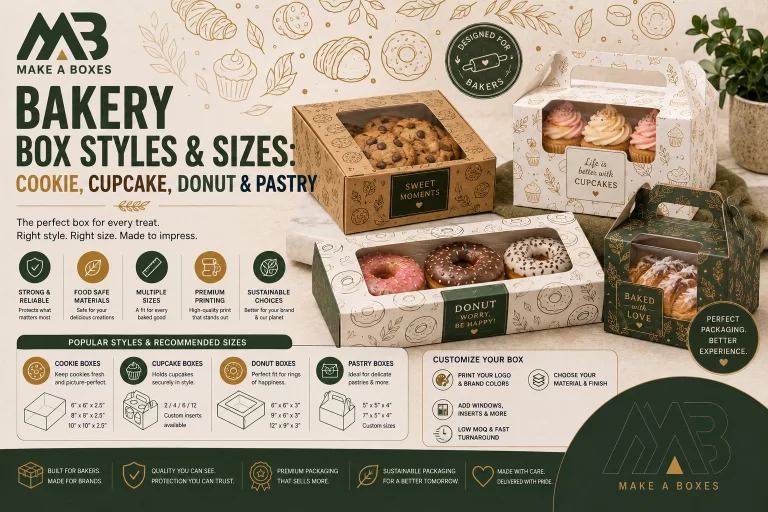
Bakery Box Styles
Where bakery box sizes follow the product, structure follows how the box is filled, carried and opened. These are the bakery box styles that cover most of the category.
| Style | Best For | Why | Watch For |
|---|---|---|---|
| Tuck-top carton | Cookies, brownies, pastries | Ships flat, fast to assemble | Not for tall decorated items |
| Two-piece lid and base | Gift sets, premium desserts | Lifts off without touching product | Slower to pack, higher cost |
| Auto-lock bottom | Heavier mixed orders | Strong base, quick set-up | More board per unit |
| Window carton | Anything sold on appearance | Shows product before purchase | Film choice and cost |
| Gable / handled box | Takeaway and gifting | Carries level, easy to hold | Handle weakens under weight |
| Compartmented box | Cupcakes, macarons, assortments | Stops item-to-item contact | Insert adds cost and pack time |
Cookie Boxes
Cookies are the most forgiving bakery product to package and the easiest to get wrong through carelessness. They stack, they tolerate handling, and they fail at the edges; a chipped rim or a cracked corner reads as staleness even on a cookie baked that morning.
Snug low-profile bakery box sizes work best here, with the stack height matched to the box so the top cookie is not free to move. Our cookie boxes stack cleanly and pack fast, which matters more here than in any other bakery format because cookies are usually sold in volume rather than singly.
The exception is the single-cookie market event favors, corporate gifting, and individually sold decorated cookies where the packaging is doing presentation work rather than protection work. Individual cookie boxes turn one cookie into a gift, and the sizing logic inverts: the box is deliberately larger than the product so the cookie is presented rather than contained.
Cupcake Boxes
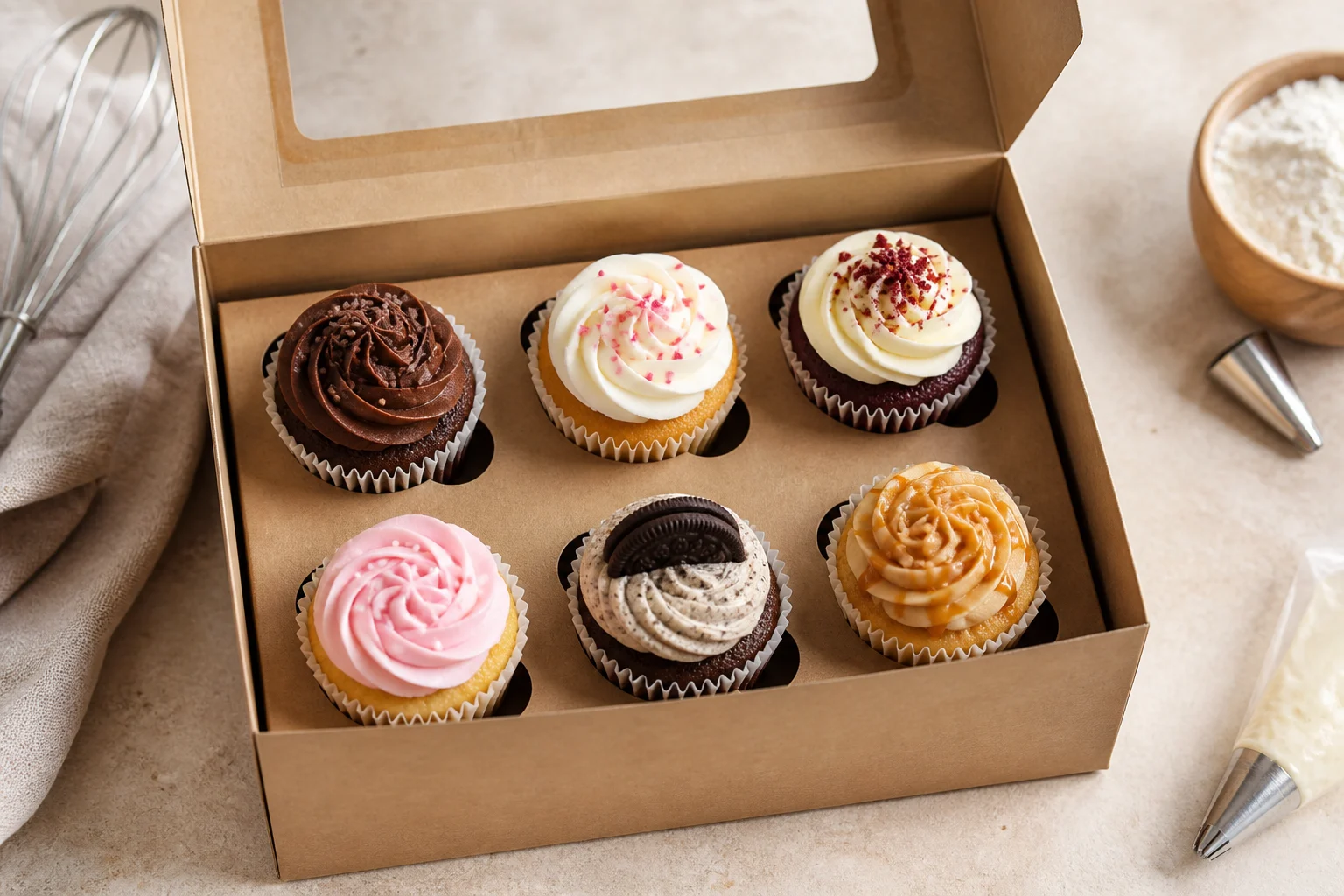
Cupcakes are the format where inserts stop being optional. Frosting is the entire visual product; it sits above the case with nothing supporting it, and it transfers to any surface it touches. A cupcake that tips in transit is not damaged; it is destroyed.
Three configurations cover the market. Single-cupcake boxes for individual sales and favors; multi-cupcake boxes in four, six, and twelve counts for standard retail; and fully customizable formats for mixed orders. Our cupcake boxes take inserts that hold each cupcake securely, which is what keeps them upright and stops icing smudging against a neighbor or a lid.
Two sizing details matter. The cavity has to grip the case, not the cupcake, because case diameters are consistent while frosting is not. And the lid clearance has to account for the tallest frosting your bakers actually pipe, not the average; mini cupcakes in particular shift easily in boxes sized for standard ones, which is why a dedicated mini format is worth having rather than reusing a larger box.
Donut Boxes
Donuts bring a problem no other bakery item has to the same degree: the product is sticky on its outer surface, and it is the surface that touches the box. Glaze transfers, chocolate frosting marks the lid, and a donut that slides arrives with its coating on the board instead of on itself.
Formats run from single donut boxes through mini and half-dozen counts to full dozen trays. Our donut boxes are built for the full range of styles: glazed, frosted, filled, crullers, beignets, and donut holes, and the specification that matters most is internal height. Enough clearance that the lid never contacts the glaze, but not so much that the donut can slide.
Windowed donut boxes are unusually effective in this category, because donuts are bought impulsively and on appearance. Being able to see the assortment before buying does real work at a counter.
Pastry and Mixed Dessert Boxes
Pastry boxes are the hardest to standardize, because the products are irregular, fragile, and often sold as an assortment rather than a set count. Croissants flake, danishes have jam that sticks, and an eclair does not stack at all.
The working answer is usually a flat, snug box with a divider system rather than a fitted insert, since a divider accommodates variety in a way a molded cavity cannot. For mixed dessert orders, plan the layout around the most fragile item and the heaviest item, and keep them apart. Bakery gift boxes holding multiple items securely are the same problem with a presentation requirement layered on top.
Bakery Boxes with Window
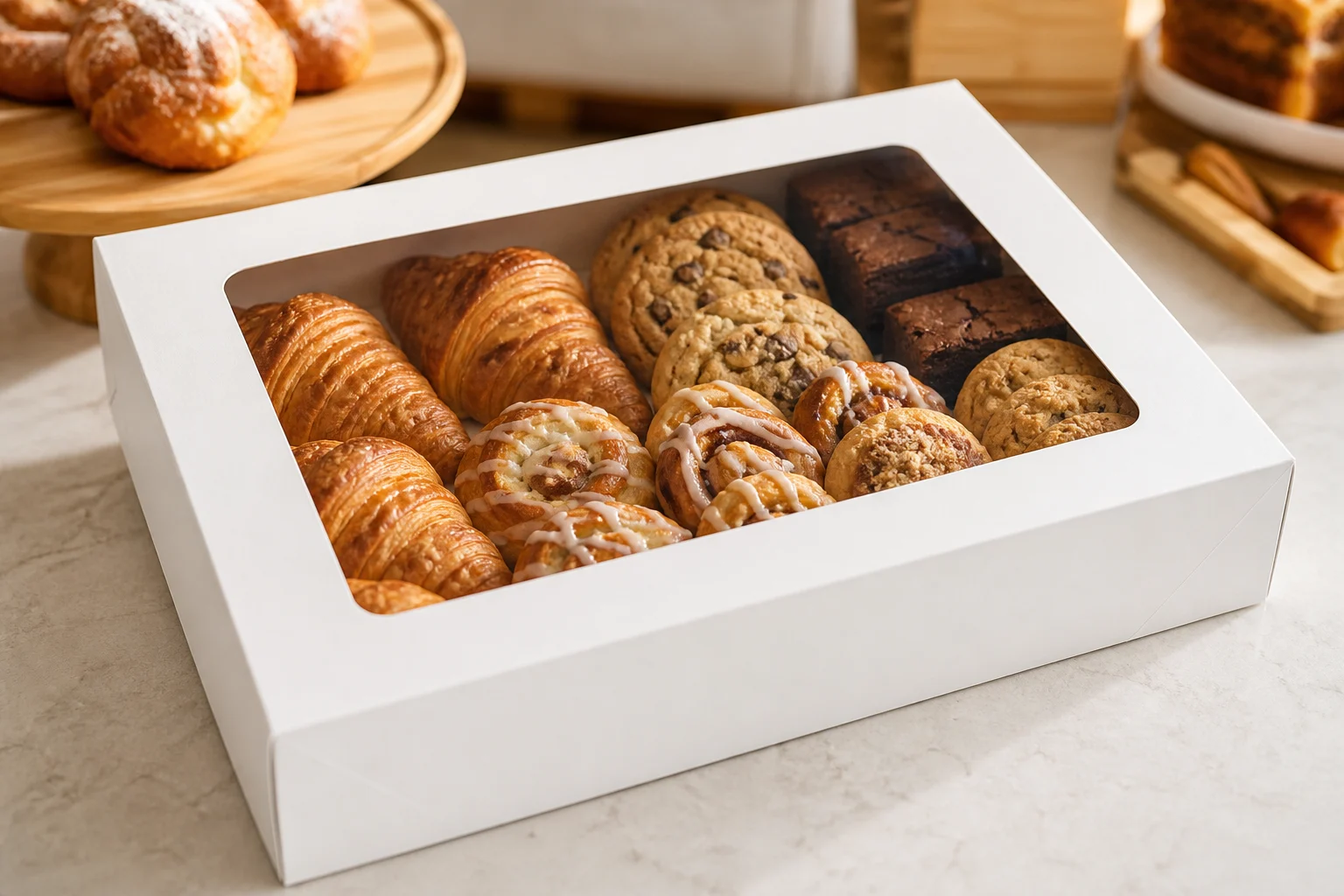
A window converts a closed carton into a display unit, and in a category where products sell on appearance, that is a genuine revenue lever rather than a cosmetic choice. Window bakery boxes showcase freshness and drive impulse purchases while the structure still protects what is inside.
Two decisions determine whether it works. Film-backed windows keep the box sealed while showing the product, which suits anything that dries out or picks up odors. Open cut-outs allow airflow, which suits crusty items that go soft when sealed and ruins glazed items that need protection from air. And window placement affects strength: a large cut-out in a lid reduces the panel’s rigidity, so a windowed box carrying weight usually needs a heavier caliper than the same box without one.
Inserts, Dividers and Layout
The insert is what turns a box into packaging for a specific product. Fitted inserts hold cupcakes, macarons and cookies firmly in place and prevent deformation during transport. Dividers suit mixed assortments where cavity sizes cannot be predicted. Both add cost per unit and time per pack, which is a real consideration in a bakery filling dozens of orders during a morning rush.
The economy worth pursuing is a shared footprint across bakery box sizes. If your cupcake, cookie, and assortment boxes use the same external dimensions with different inserts, you hold one box and three inserts rather than three of everything, which is cheaper to buy, simpler to store, and faster to reorder.
Board, Grease and Moisture
Bakery products attack packaging in two directions. Butter and oil migrate outward, showing through as translucent patches on printed panels; brownies and pastries are the worst offenders. Moisture moves both ways: a warm item sealed immediately will steam and soften its own crust, while a dry item in a ventilated box will stale faster.
Grease-resistant coatings, liners or a wrapping sheet between product and board all solve the first problem, and the wrapping sheet is often the cheapest route because it lets the carton be specified for structure and print rather than direct contact. Ventilation solves the second, and it is why some bakery formats are deliberately not sealed. Eco-positioned bakeries should note that coatings and liners affect recyclability; the claims involved are covered in our guide to biodegradable food packaging claims.
When a liner, wrapping sheet or coated board directly touches food, verify that every relevant component is suitable for the intended food type, temperature and contact duration. The FDA distinguishes between dry, fatty, aqueous, refrigerated, frozen and heated conditions of use. See the FDA’s food-contact conditions-of-use guidance.
For oily pastries, cookies and brownies, a separate wrapping sheet can provide grease control at the contact surface while allowing the outer carton to be specified primarily for structure and printing. Compare the available paper and coating options in our custom wax paper guide.
Stacking, Assembly and the Working Bakery
Two operational factors get left out of specifications and then cost money every day.
Stacking strength determines whether boxes can be filled and held before collection. Fortified edges prevent accidental opening, and boxes need to support weight when stacked without collapsing; a box that is fine individually can fail three high. Flat storage before assembly matters too: a busy bakery has limited space, and pre-assembled formats consume it.
Assembly time is the other. A format that takes ten seconds longer to fold costs an hour a week at a hundred boxes a day. When comparing two structures, fold one of each by hand before deciding; it is the fastest test in packaging, and almost nobody does it.