
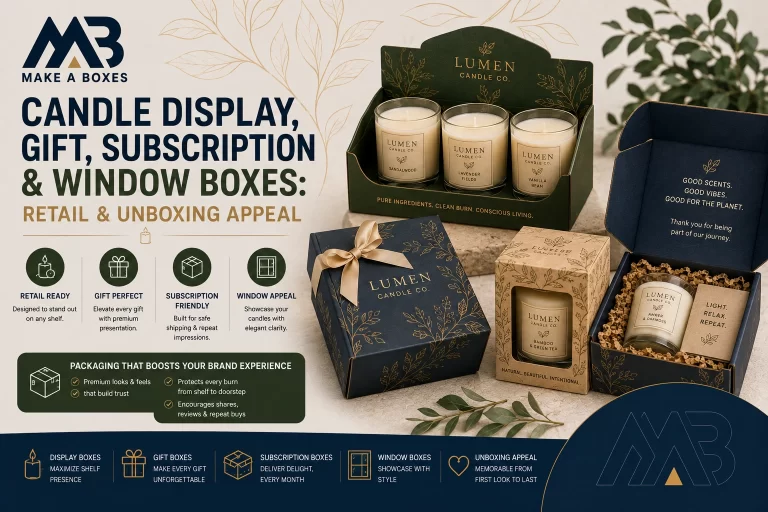
Candle Display Boxes for Retail
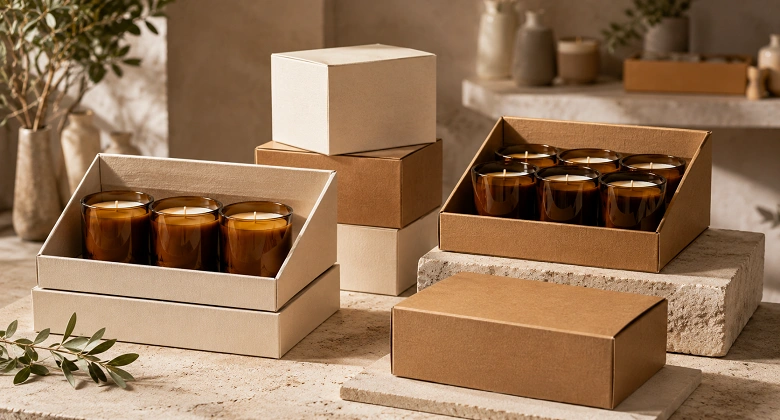
Candle display boxes are the only format on this list handled by strangers, over and over, for weeks. That single fact drives every decision about it. Candle display boxes do not have to survive one journey; they have to stay presentable after a hundred people have picked up a unit and put it back.
Counter, Shelf or Floor?
Counter displays hold a small number of units near the register and work on impulse. Shelf-ready formats arrive packed and open into a facing, which is what larger retailers increasingly require. Floor-standing units carry the most stock and are the hardest to specify, because the structure has to bear real weight without bowing. Start from where the retailer will actually place you rather than from the unit you would like to build.
Weight Is the Constraint Nobody Plans For
Filled glass candles are dense. A display holding six 12 oz jars carries several pounds, concentrated high if the structure is tiered, and a board specified by appearance rather than load will bow within days. Reinforced side panels, a corrugated inner structure, and interlocking base tabs are what keep candle display boxes square through a retail cycle. This is the most common point of failure in the format and the least visible in a proof.
What Retailers Actually Need From You
Two practical things, both easy to overlook. The unit should ship flat and assemble without tools, because staff time is the retailer’s cost and a fiddly display gets left in the stockroom. And the footprint should match standard shelf depths; a display an inch too deep will not be sited, however good it looks. Ask the buyer for their shelf specification before you commission a dieline.
Structural options across the wider range are covered in our guide to candle box sizes and styles, and you can see current formats on our custom candle boxes page.
Seasonal and Limited-Edition Displays
Seasonal ranges are where candle display boxes pay for themselves fastest, because a retailer will give a themed unit floor space they would never give a permanent facing. The economics only work if you separate the structure from the artwork: build one reinforced base that you reuse, and change the printed sleeve or header card each season.
Two things to plan for. Seasonal displays need to be with the retailer well before the season starts, so work backwards from their planogram date rather than the shopping period. And themed units get discarded rather than restocked, so specify them for one cycle at a lower cost per unit instead of building for a durability nobody will use.
Candle Boxes with Window
A window converts a closed box into a display in its own right, which is why the format sits between retail and gifting. Our candle boxes with window work to a typical inner size of 80 × 80 × 100 mm and cover vessels from 2 oz to 16 oz, with PET, PVC or biodegradable clear film.
Film quality affects appearance and shelf suitability, so ask the supplier to document the material, thickness, expected storage conditions and compatibility with the finished box. Thin or unsuitable film can scratch, distort or lose clarity during handling and storage.
Terms such as biodegradable, compostable and plant-based do not automatically mean that a window is recyclable or suitable for home composting. The FTC Green Guides advise businesses to avoid broad environmental claims and to explain the specific benefit and relevant limitations. Identify the film, required disposal conditions and supporting certification instead of describing the complete window box as eco-friendly.
For a fuller explanation of material and disposal claims, read our sustainable candle packaging guide.
Windows earn their cost when the wax color or a layered pour is part of the appeal, and when the fragrance name alone does not communicate the product. They are worth avoiding on anything where the wax surface can collect dust before sale, and on wax melts, where an unbacked cut-out is simply a route for fragrance to escape.
Candle Gift Boxes
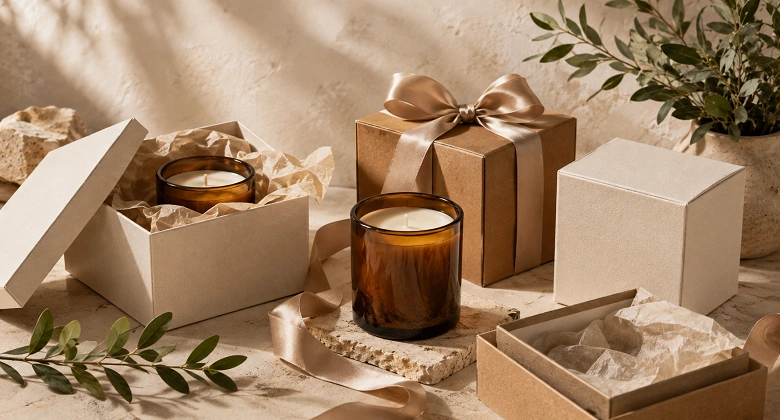
Gift packaging is judged twice: once by the person buying it and once by the person opening it, and those two people want different things. The buyer wants it to look worth the money on a shelf. The recipient wants a moment. Structure serves the second; print serves the first.
Our candle gift boxes work to a typical inner size of 85 × 85 × 100 mm, adjustable, and suit single or multiple candle formats. Where sets are involved, the internal layout does most of the work: a compartmented insert that holds each item square, an accessory pocket for a matchbox or trimmer, and enough finger clearance that the first item lifts out without the customer tipping the whole box.
Seasonal ranges are worth planning as a sleeve over a fixed structure rather than a new box each time. The artwork changes, the tooling does not, and the cost of a holiday edition drops considerably. Finish choices that carry the most perceived value are covered in our guide to choosing luxury candle packaging.
Candle Subscription Boxes
Subscription packaging has a constraint no other format shares: the same person opens it every month. Novelty stops working after the second delivery, so the design goal shifts from surprise to reliable, repeatable quality. Our candle subscription boxes work to a typical inner size of 90 × 90 × 120 mm and fit glass, tin and jar candles.
Three things matter more here than elsewhere. Cost per unit compounds; a small saving repeated twelve times a year across a subscriber base is a material number. Packing speed compounds the same way, so a five-component pack that takes three minutes is a genuine operational cost once volume arrives. And the box has to survive a courier network every time without a retail carton inside it, which usually means corrugated with a fitted insert rather than a presentation structure.
The design that works is usually a consistent outer with a variable insert card or sleeve; the customer gets something new each month without you retooling, and your unit economics stay stable.
Two Components That Serve Every Format
The Candle Box Insert
An insert does the same job in all four formats: it stops the vessel from moving. In a display, it keeps units square and facing forward; in a gift set, it separates components; in a subscription mailer, it is the only thing between the candle and the courier network. Our candle box inserts are die-cut from corrugated board, kraft or eco pulp using CAD-based cutting and compression testing, so the cavity matches the vessel rather than approximating it.
Designing one insert footprint that works across formats is the single most useful economy available here. If the display, the gift box and the subscription mailer all take the same cradle, you hold one component instead of three.
Custom Candle Dust Covers
Dust covers are the cheapest presentation upgrade in the category and the most underused. On a display unit, they keep the wax surface clean through weeks of shoppers handling the product. In a gift box, they add a layer to open. In a subscription pack, they turn a plain vessel into something branded without a second carton. Our custom candle dust covers are die-cut from kraft or linen-textured recycled paper and sized from small votives up to 16 oz jars.
Designing for the Unboxing Moment
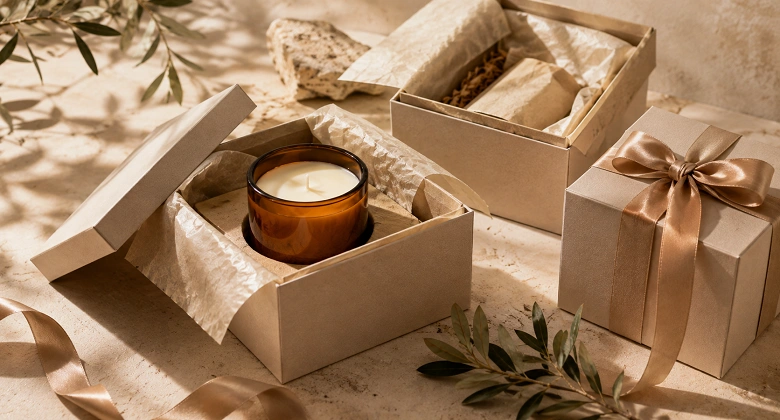
Unboxing is a sequence, not a surface. What the customer registers is the order in which things happen: the outer opens, something is revealed, the product lifts out cleanly, and there is a reason to look again. Each of those is a structural decision made before any artwork exists.
Two failures are common. A pack so tightly fitted that the candle has to be pried out converts a good moment into an awkward one. And a printed inner surface that nobody sees, because the structure opens the other way, is worth checking on a physical sample rather than a flat proof.
Which Format Do You Actually Need?
If you sell through stockists, candle display boxes and shelf-ready formats come first, because they determine whether you are sited at eye level or on a bottom shelf. If you sell direct at gifting occasions, gift structure and finish carry the return. If you run a recurring program, subscription economics dominate, and presentation is secondary to cost and packing speed.
Most brands need two of the four, not all of them. The efficient way to run several is to standardize the insert and the vessel, then vary only the outer, which keeps tooling costs down and makes the range look deliberate rather than assembled.