
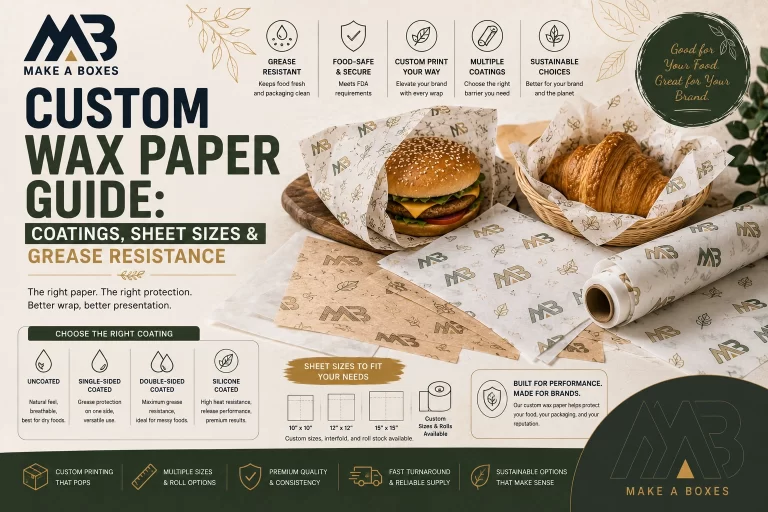
Wax Paper, Greaseproof, Parchment or Butcher Paper?
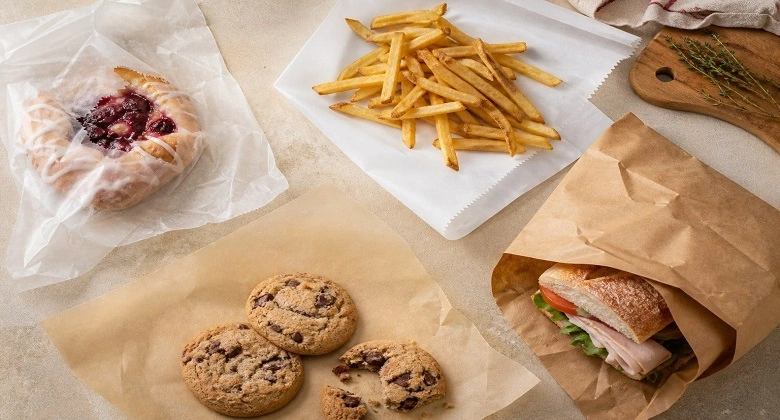
The difference is in how each one is manufactured, and that determines what it can survive.
| Paper | How It Resists Grease | Heat Tolerance | Best For |
|---|---|---|---|
| Wax paper | Wax coating on the surface | Low — wax softens and melts | Cold and ambient wrapping, liners, deli |
| Greaseproof | Dense refined fiber, low porosity | Moderate | Burgers, fried food, pastries |
| Parchment | Acid treatment plus silicone | High — oven-safe | Baking, roasting, tray lining |
| Butcher paper | Uncoated kraft with sizing agents | Moderate | Meat, produce, breathable wrapping |
The distinction that causes the most confusion is wax paper versus parchment. The two products can look similar but are not interchangeable.
Wax-coated paper should not be used in an oven unless the manufacturer’s documentation expressly authorizes the specific product for that temperature and application. Parchment intended for baking normally uses a heat-resistant treatment, but its maximum temperature and contact time still depend on the exact substrate and coating.
Do not publish a universal oven-temperature claim for “butter paper,” parchment or wax paper. Confirm the rated temperature, contact duration and food type for the exact material being supplied, and include those limitations in the product specification.
How Does Custom Wax Paper Work?
Custom wax paper is a base sheet with a wax coating applied to one or both faces. The coating fills the surface porosity so oil and moisture cannot wick into the fiber, and it adds a degree of non-stick release. The base sheet does the structural work; the coating does the barrier work.
Which Coating Should You Specify?
Our custom wax paper is available with a classic wax coating for straightforward water and grease resistance, a food-safe plant-based coating for eco-positioned brands, a single-side coating that leaves the other face breathable, and a fully coated version for maximum moisture and grease resistance.
The single-side option is the one worth understanding, because breathability is a feature rather than a shortcoming. A fully sealed wrap traps steam against a hot item, which softens a crust. A sheet coated on the food side only lets moisture escape through the outer face, which is why crusty bakery items and hot sandwiches often wrap better in a one-side sheet than a fully coated one.
Which Paper Base?
The base changes the character as much as the coating does. Natural kraft gives strength with a rustic look and hides marks. Translucent greaseproof suits delicate pastries and bakery display. Silicone-coated bases handle non-stick baking and roasting. Recycled post-consumer stock covers eco requirements, and extra-strong bases resist tearing during heavy folding or wrapping. Choose the base for what the paper has to physically do, then the coating for what it has to resist.
Greaseproof Paper: A Barrier Without a Coating
Greaseproof paper is the one people assume is coated, but it is not. It gets its resistance from the pulp itself: the fiber is refined and beaten until the sheet’s porosity drops far enough that oil cannot penetrate. That dense structure is the barrier.
The practical advantage is that there is no coating to melt, crack or complicate disposal, which makes greaseproof a strong choice for hot, high-fat foods. Our greaseproof paper is offered in food-grade pulp, semi-bleached kraft or coated greaseproof, and it is the sensible default for burgers, fried snacks and anything served hot and oily.
What GSM Do You Need?
Paper weight is measured in grams per square meter, and it is the specification most often left to the supplier by default. Two bands cover most food service use: roughly 35–45 gsm for standard wrapping, and 50–60 gsm for high-fat foods and heavy-duty applications. Butter and baking papers sit lower, around 30–40 gsm, because they need flexibility more than bulk.
Going heavier is not automatically better. A thicker sheet is stiffer, folds less cleanly around an irregular item, and costs more per wrap. The failure you are designing against is oil reaching the outside of the sheet within the product’s serving window, not indefinitely. A burger wrapped for a ten-minute delivery does not need the same sheet as a pastry sitting in a display case all afternoon.
Sheets, Rolls or Bags?
Format is an operational decision more than a packaging one, because it determines how fast your staff can work.
- Wax paper sheets are fastest for repetitive wrapping at a counter. Typical sizes run 300 × 400 mm, 500 × 700 mm and 600 × 900 mm, with custom dimensions available.
- Rolls suit variable item sizes and tray lining, in widths of 300 mm, 450 mm and 600 mm with customizable lengths.
- Bags suit items handed straight to a customer: pastries, fries, sandwiches in small, medium and large formats from roughly 150 × 250 mm up to 350 × 500 mm.
Size to the item plus the fold, not to the item. A sheet that only just wraps leaves no overlap, and the wrap opens in a delivery bag. Order one size up from what looks sufficient on a bench.
Custom Printed Wax Paper
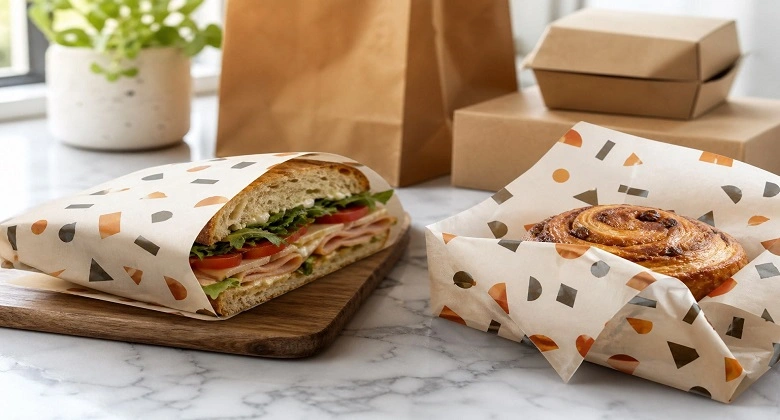
This is where wrapping paper stops being a consumable and becomes brand presence. Custom printed wax paper is seen at the single most attentive moment in the whole customer experience: the unwrap, and it costs far less per impression than a printed carton.
Two constraints shape the design. Inks must be heat-stable and suitable for the contact involved, which is why print detail on wrapping paper is usually simpler than on a carton. And oil darkens paper, so a design that relies on pale tonal contrast will disappear on a greasy item. Bold, high-contrast marks and repeating patterns hold up; fine gradients do not.
Finish options are available in smooth, lightly textured, or matte, and the textured finishes fold more predictably, which matters more than it sounds when someone is wrapping several hundred items a shift.
When Does a Wrap Beat a Box?
Three situations, and they cover a lot of food service.
When the item is irregular. A sandwich, a filled bagel, or a slice of pizza does not fit a rectangular carton without wasted volume, and paper conforms to it exactly.
When the box would fail on grease. A wrapping sheet solves the barrier problem at the contact surface, which means the outer carton can be specified for structure and print rather than for direct contact. That is frequently the cheaper route to a compliant pack, and it is also why paper and cartons work better together than either alone. The bakery formats where this combination matters are covered in our bakery box styles and sizes guide.
When speed matters. A wrap takes a fraction of the time to close that an assembled carton does, and at counter volume that difference is real money.
Compliance, Coatings and PFAS
Grease-resistant paper has been directly affected by changes involving fluorinated grease-proofing treatments.
The FDA states that PFAS-containing grease-proofing substances are no longer being sold for food-contact use in the United States and that the associated authorizations were made ineffective after manufacturers abandoned those uses. See the FDA’s current PFAS food-contact information.
For buyers, the practical question is not simply whether a sheet is described as “PFAS-free.” Ask what provides the grease resistance:
Mechanical refining of the paper
Wax coating
Silicone treatment
Plant-derived coating
Another non-fluorinated barrier
Each option behaves differently under heat, oil, moisture and folding. Request documentation covering the specific coating, paper base, intended food type, temperature and duration of contact.
State and international requirements may impose additional restrictions. Our food-safe packaging materials guide explains what documentation to request before approving the material.