
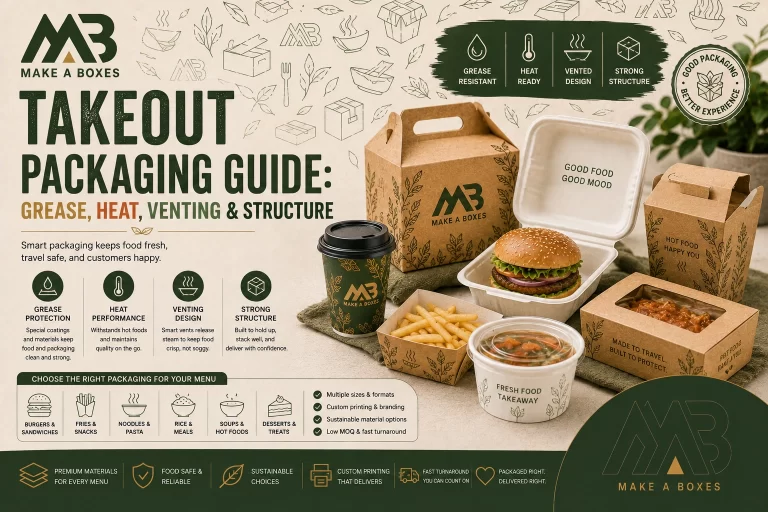
Why Does Takeout Arrive Soggy?
Because hot food is wet food. Anything served hot is releasing steam, and a closed box has nowhere for that steam to go. It condenses on the inside of the lid, runs back down onto the product, and softens whatever it lands on. Fries lose their crisp coating in minutes. A burger bun turns to paste on its underside. Batter separates from fried chicken.
The instinct is to seal the box more tightly, and that makes it worse. A better seal traps more steam. The correct answer for most hot food is deliberate ventilation vents, perforations, or a structure that does not close completely.
The Trade-Off Nobody Tells You About
Here is the part that makes takeout packaging genuinely difficult: heat retention and crispness are opposing requirements, and no single specification delivers both.
A sealed, insulated box holds temperature well. It also holds steam, which destroys texture. A vented box preserves texture and lets heat escape faster. You cannot have both in one container, which means the decision has to be made per item rather than per order.
The practical resolution is separation. Fries go in a vented open format, the burger goes in its own box, and sauces travel separately. Combining them into one sealed container to save on packaging is a false economy; it costs less per order and produces a worse meal every time. Operators who fix their soggy-fries problem almost always fix it by splitting the pack, not by upgrading the board.
Grease Resistant Food Boxes
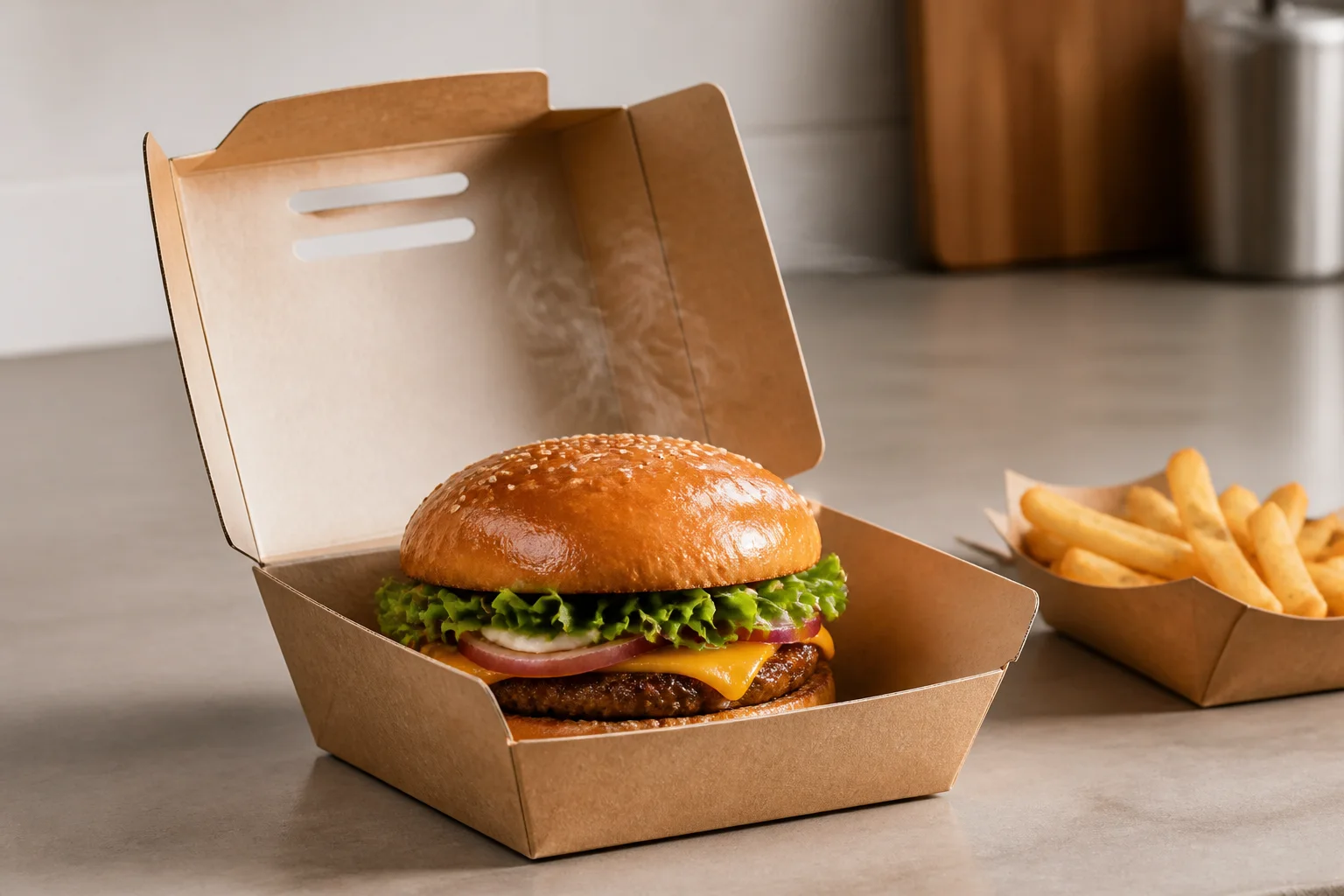
The second fast food packaging failure is oil. Fats wick into uncoated fiber and appear on the outside as translucent patches, usually within the delivery window rather than after it. A branded box with a grease shadow across the logo does more brand damage than plain packaging would.
A liner or wrapping sheet can provide grease control directly at the food-contact surface, allowing the outer carton to be selected primarily for structure and printing. Our custom wax paper guide compares wax-coated, greaseproof, parchment and other food-wrapping options.
It is also important to identify what creates the grease resistance. The FDA reports that PFAS-containing grease-proofing substances are no longer being sold for food-contact use in the United States and that the associated Food Contact Notifications are no longer effective. See the FDA’s current PFAS food-packaging update.
Ask the supplier to identify the coating or treatment, provide its food-contact basis and confirm suitability for the intended food type, temperature and contact duration. “Grease-resistant” and “PFAS-free” are claims; the actual coating and its documented conditions of use are the specification.
Burger Boxes
A burger is a stack held together by nothing, and fast food packaging either preserves that stack or destroys it. Two formats compete.
A wrap is cheap, fast, and conforms to the burger, but it compresses, which suits a thin classic burger and ruins a tall stacked one. A box holds the burger’s height and shape, keeps toppings in place, and gives a full printed surface, at a higher cost per unit and a slower close.
Our burger boxes are built with reinforced edges and locking tabs so the structure holds through transport, and sized across the range from mini sliders to large stacked specialty burgers. That range matters more than it sounds: a box sized for a double patty leaves a single burger loose enough to tip, and a tipped burger arrives disassembled. If your menu spans heights, you need at least two sizes, not one generous one.
Specify internal height to the tallest build you actually sell, and check that the lid clears it without compressing. A box that closes only by squashing the burger has failed before it leaves the kitchen.
Fry Boxes and Open Formats
Fries are the hardest item in fast food packaging, because they generate steam faster than anything else on the menu and they are judged almost entirely on texture.
This is why fry packaging is traditionally open or heavily vented: scoops, cartons with open tops, cups. The open top is not a cost-saving; it is the feature. Steam escapes rather than condensing, and the fries stay crisp for the length of a normal journey. Our french fry boxes are made from food-grade paperboard built to handle heat, oil, and quick movement, which is the specific combination this item demands.
For delivery rather than counter service, the tension sharpens: an open format spills in a bag carried at an angle. The workable compromise is a vented closed format or a fry box held upright in a carrier, rather than sealing the fries into a container where they will steam themselves soft.
Hot Dog Boxes and Long-Format Items
Hot dogs, subs and wraps share a geometry problem: they are long and narrow, which means the packaging has almost no structural depth to work with and bends easily along its length.
The other issue is condiments. Sauces migrate along the length of a long item and pool at whichever end is lowest, which in a delivery bag is unpredictable. A tray or box with a defined channel keeps the item centered and the sauce where it was applied. Our hot dog boxes use folds and locking tabs to keep food stable during quick service, which is the operational reality this format is built around: vendors filling and closing in seconds during a rush.
Structures for Custom Takeout Boxes
Fast food packaging structures follow food type and service model more than budget.
| Structure | Best For | Ventilation | Watch For |
|---|---|---|---|
| Clamshell | Burgers, combo items | Vents required | Seals steam if unvented |
| Open scoop / carton | Fries, wings, snacks | Naturally vented | Spills in delivery bags |
| Tuck-top carton | Dry or coated items | Low | Not for very hot, wet food |
| Auto-lock bottom | Heavier orders | Low | Strong base, more board |
| Tray with sleeve | Long items, meals | Moderate | Two components to hold |
| Wrap or sheet | Thin burgers, subs, deli | High | Compresses tall builds |
Sizing across formats starts small; our fast food packaging runs from around 120 × 80 × 60 mm for fries and snacks upward through burger, sandwich and combo formats. The full range is on our fast food boxes page.
Counter Service or Delivery?
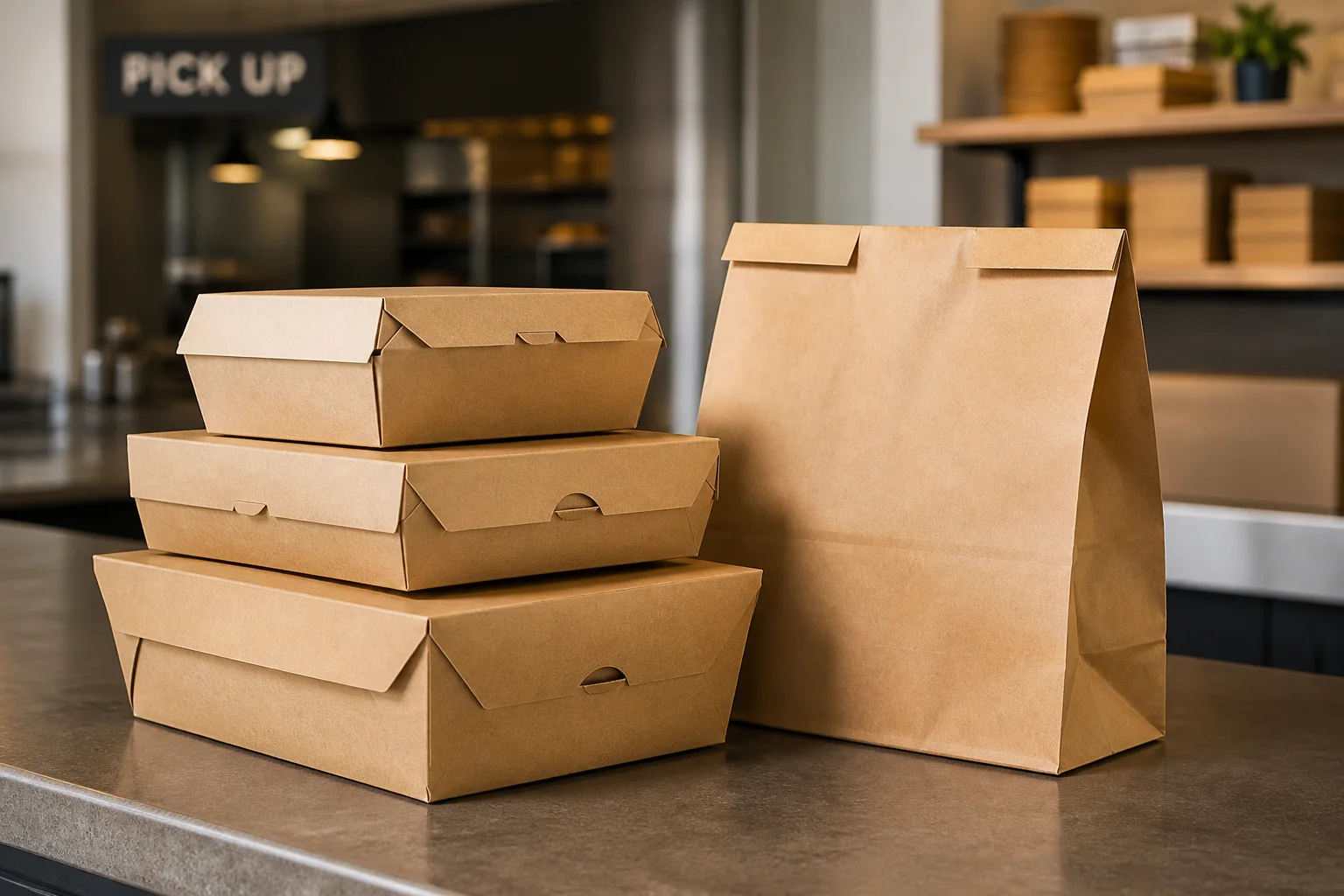
The same food needs different packaging depending on how it travels, and this is where most operators overspend in one place and underspend in another.
Counter service is a short, controlled journey. Speed of assembly matters most, ventilation matters, and structural strength matters least; the customer carries it themselves, level, for two minutes.
Delivery changes every variable. The bag is carried at an angle, packages stack on each other, journey times vary, and nobody checks the contents on arrival. That demands closure security, a base that survives being sat under another order, and tamper evidence. It also raises the value of packaging that arrives looking intact, because in delivery the packaging is the only physical brand contact the customer has.
Tamper Evidence
Third-party delivery made this a standard expectation rather than a premium feature. The cheapest implementation is a sticker or label across the closure; the better one is a structural tamper-evident tab built into the die, which cannot be resealed once broken and does not add a step at the packing bench.
If you are redesigning takeout packaging and delivery is a meaningful share of orders, specify it into the structure rather than adding it as a consumable.
Print, Grease and Speed
Two constraints shape artwork on fast food packaging. Oil darkens board, so designs relying on subtle tonal contrast disappear on greasy items; bold, high-contrast marks survive. And kraft hides marks better than bleached white, which matters on packaging handled with greasy hands during a rush.
The third constraint is not visual at all. A structure that takes five seconds longer to assemble costs real money at fast food volume, and a box that needs two hands to close slows a line more than any other packaging decision. Fold candidates by hand before choosing between them.