
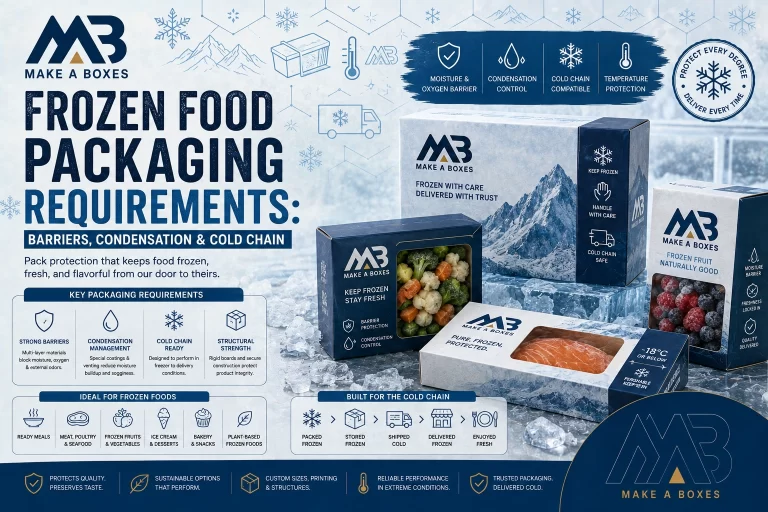
What Causes Freezer Burn?
Freezer burn is a quality problem caused by moisture loss from the surface of frozen food. Air exposure, unsuitable packaging, poor seals and packaging that is too permeable can all contribute.
The USDA Food Safety and Inspection Service explains that proper packaging helps maintain quality and prevent freezer burn. It also clarifies that freezer burn does not automatically make food unsafe, although it can leave the product dry, discolored and undesirable. See the USDA’s freezing and food-safety guidance.
Effective frozen-food packaging therefore has to manage two connected requirements:
Limit moisture transfer through the package
Reduce unnecessary air exposure around the product
A high-barrier material cannot compensate for a poor seal, and a close fit cannot compensate for a material that allows excessive moisture transfer. Evaluate the barrier, closure, headspace and product together.
Barrier Film Packaging: The Two Numbers That Matter
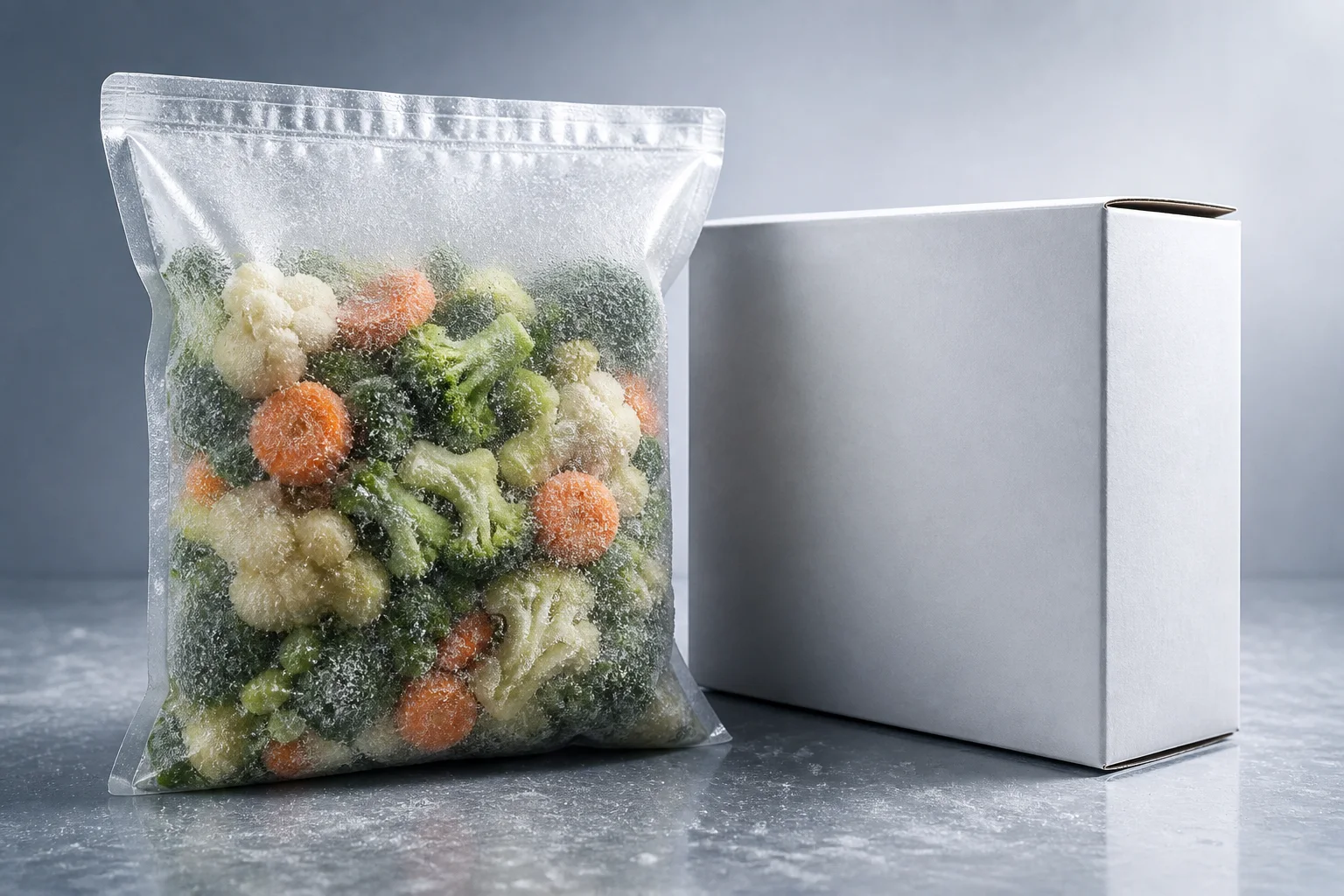
Barrier performance in frozen food packaging is measurable, and two figures describe most of it.
Moisture vapor transmission rate measures how much water vapor passes through a material over time. This is the primary number for frozen products, because moisture loss is what causes freezer burn.
Oxygen transmission rate measures oxygen ingress. It matters most for fatty products, meat, fish, anything with a high oil content where oxidation causes rancidity and color change over a long frozen life.
When a supplier describes barrier film packaging as “high barrier,” that is a marketing description rather than a specification. Ask for the transmission rates and the intended shelf life. A film adequate for six weeks of frozen storage may be inadequate for twelve months, and the difference is invisible until it is not.
Paperboard on its own is not a moisture barrier at any caliper. Frozen packs achieve barrier through a coating, a laminate, or an inner bag; the board provides structure, print surface, and stacking strength while something else does the sealing.
Condensation and the Cold-to-Ambient Cycle
Every time a frozen pack moves toward room temperature, water condenses on its outer surface. That is unavoidable physics, and it happens at every handover in the cold chain: loading, transfer, retail restocking, and the customer’s journey home.
Paperboard absorbs that moisture. As it does, it loses stiffness, coatings can lift or delaminate, and printed ink can blur or transfer. A single cycle is usually survivable. Repeated cycling is what destroys packs, and it is also the failure mode nobody tests for, because a sample checked once looks fine.
Two practical responses. Specify a coating or laminate on the outside as well as the inside where the pack will see repeated handovers; the outer face is the one collecting condensation. And test by cycling: take a filled sample from freezer to ambient and back several times over a few days, then look at the corners, the glue seams and the print. That is the test that predicts real performance, and almost nobody runs it.
How Paperboard Behaves Below Freezing
Cold changes the mechanical properties of frozen food packaging, both the board and everything holding it together.
Fiber becomes more brittle at low temperature, so scored folds crack more readily and a corner impact that would dent at room temperature can split instead. Adhesives lose flexibility, which is why glue seams are a common failure point in freezer packs and why cold-resistant adhesive specification matters more than it does anywhere else in food packaging.
The practical consequence is that a carton proven at ambient cannot be assumed to work frozen. If you are extending an existing product line into a frozen format, re-test the same structure cold rather than carrying the specification across.
Freezer Safe Packaging: Which Structures Work?
Three approaches cover most frozen food boxes, and the choice is driven by shelf life and product type.
| Structure | How It Seals | Best For | Trade-Off |
|---|---|---|---|
| Carton with inner bag | Sealed film liner | Loose items, long shelf life | Two components, extra pack step |
| Coated carton | Barrier coating on board | Short to medium frozen life | Coating limits recyclability |
| Laminated carton | Bonded film layer | Long frozen life, fatty foods | Composite; hardest to recycle |
| Tray with sealed lidding | Film sealed to tray rim | Frozen meals, portions | Requires sealing equipment |
The carton-with-inner-bag approach is worth understanding as the default. It separates the two jobs cleanly: the bag holds the barrier, the carton holds the structure, the print, and the stacking strength, and it lets you change one without re-engineering the other. It also means the recyclable component can be separated by the customer, which is a genuine advantage over a laminated board.
Our frozen food packaging covers these formats, and for chilled and frozen protein specifically, our meat boxes include frost-resistant liners and coatings built for freezing, refrigeration and moisture exposure, with vacuum bags usable inside the box to extend shelf life.
Frozen Meal Packaging and Dual-Temperature Formats
Frozen meal packaging is the hardest brief in the category, because one pack has to survive both extremes. It is stored at freezer temperature for months, then heated often in the same container in a microwave or oven.
That rules out most standard frozen food boxes and materials. The tray or board has to hold structure across a range from well below freezing to serving temperature, coatings have to remain stable when heated, and the whole assembly has to be safe for contact at both. Dual-ovenable board and heat-stable trays exist for exactly this, and they cost more than either a frozen-only or an ovenable-only format would.
Two specification points to nail down early. Confirm the temperature range in writing, both ends. And confirm whether the pack is intended for microwave, conventional oven or both, because the requirements differ; a material that is microwave-safe is not automatically ovenable. This is also an area where documentation for the intended use matters, as covered in our guide to food-safe packaging materials.
Printing, Labels and Adhesives in the Cold
The most common avoidable failure in frozen food packaging has nothing to do with the food. Labels fall off.
Standard pressure-sensitive adhesives lose tack at low temperature, and a label applied to a surface that is already cold and slightly damp may never bond properly at all. Freezer-grade adhesives are formulated for this, and the application condition matters as much as the adhesive; applying to product that is already frozen is harder than applying before freezing.
Printing has its own constraint: inks need to tolerate the moisture cycling described above without blurring or lifting. Direct print on a coated board generally outperforms an applied label in a freezer environment, which is worth weighing if your artwork is stable enough to commit to the board.
Stacking, Storage and the Cold Chain
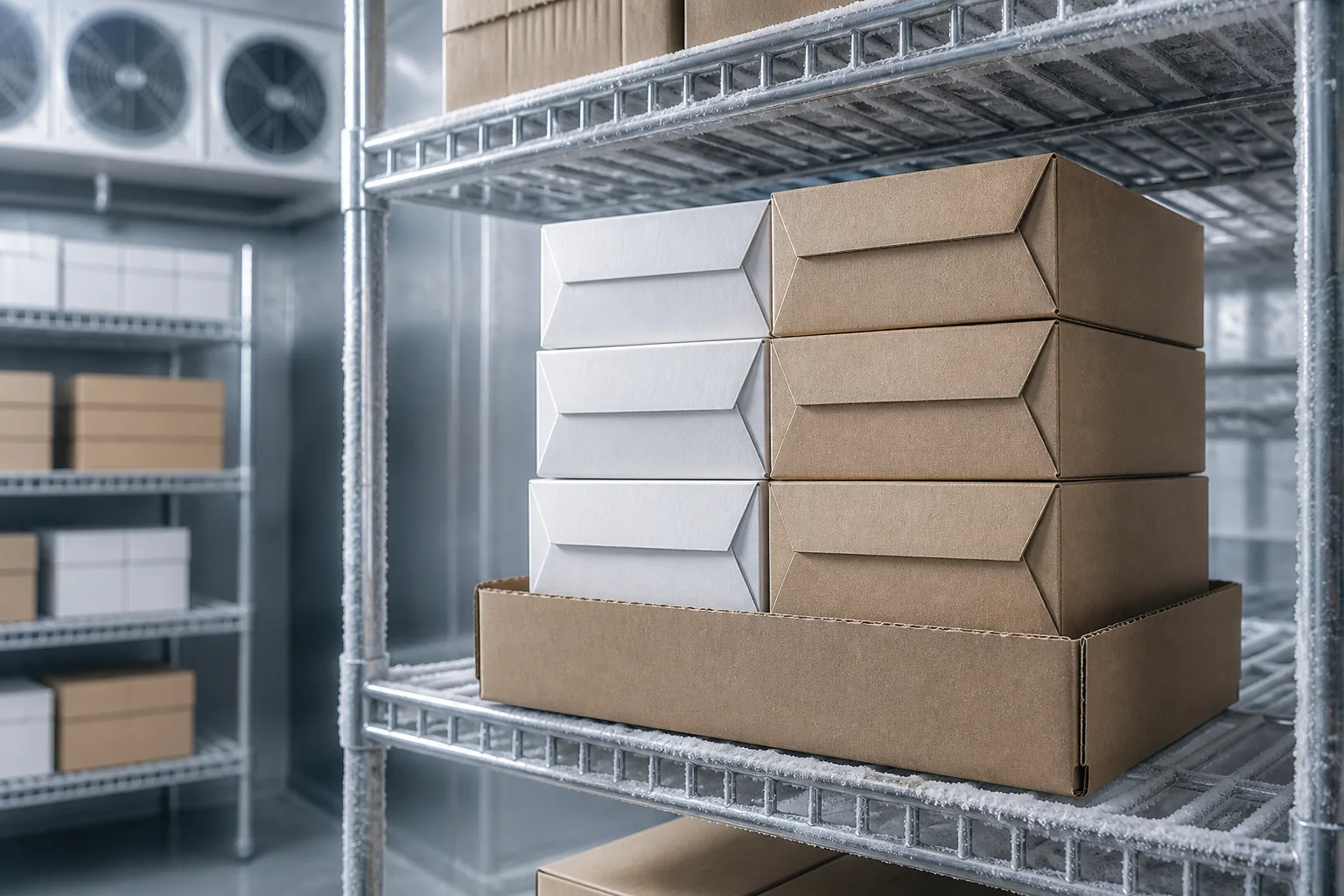
Frozen product is dense, and frozen food boxes are usually stored stacked for long periods rather than shipped individually. That makes compression strength over time not impact resistance, the structural property that matters.
Two things degrade it. Moisture from condensation softens board, so a stack that is stable when dry can settle over weeks in a humid cold store. And blast freezing puts packs through rapid temperature change, which stresses seams. Specify with the actual storage duration in mind rather than the shipping journey, because in frozen storage, it’s the hard part.