You’ve spent months developing your formula. You’ve tested it on friends, refined the scent, and perfected the texture. Now comes the part nobody warned you about in beauty school or business planning guides: packaging.
Specifically, the moment you discover that most packaging suppliers want you to order 5,000 units before they’ll even return your email.
For indie beauty founders, this is one of the most common and most discouraging roadblocks between a great product and a shelf-ready brand. But low MOQ cosmetic packaging is not a myth. It exists, it’s accessible, and understanding how it works can be the difference between launching this quarter and waiting another year.
This guide breaks down everything small beauty brands need to know about minimum order quantities, what to look for in a packaging partner, and how to make smart decisions that protect your cash flow without compromising on quality.
What Is MOQ and Why Does It Matter So Much in Cosmetics?
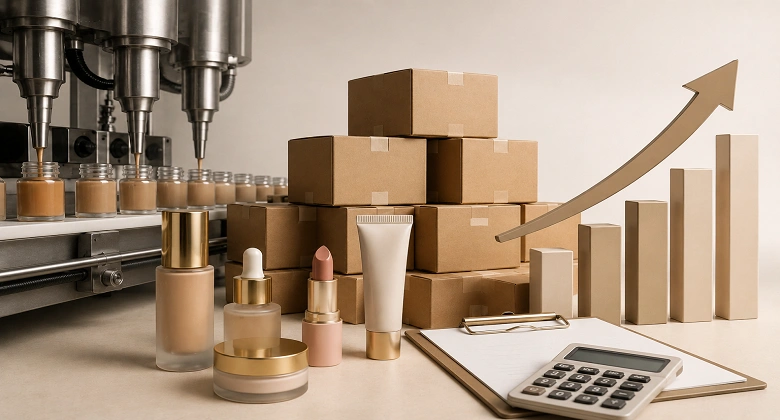
MOQ stands for minimum order quantity, the smallest number of units a supplier will produce in a single run. In the cosmetics packaging industry, MOQs are typically driven by the economics of manufacturing: setup costs, tooling, material sourcing, and press time don’t scale down easily. A factory calibrated to run 10,000 lipstick tubes isn’t going to retool for 50.
For large beauty brands, a 5,000-unit MOQ is barely a rounding error. For a founder launching their first serum or lip gloss, it represents thousands of dollars in upfront inventory, warehouse space they don’t have, and the terrifying prospect of being stuck with 4,800 unsold units if the product doesn’t take off immediately.
The mismatch is structural and it’s exactly why the demand for low-minimum suppliers has exploded alongside the indie beauty boom.
The Real Cost of High MOQs for Small Beauty Brands
High minimum orders don’t just create a cash flow problem. They create a cascade of downstream risks that can stall or permanently derail a small brand.
- Tied-up Capital: Every pound or dollar spent on packaging that sits in storage is money not going into marketing, product development, or customer acquisition. Early-stage brands live and die by liquidity.
- Commitment Before Validation: Ordering 5,000 units of a product before you know whether your audience wants it is a bet most small founders can’t afford. A lower minimum lets you test the market, gather feedback, and iterate without betting the whole business on a single SKU.
- Inflexibility As You Grow: Beauty trends move fast. Seasonal shades, limited editions, and formula tweaks are part of how indie brands stay relevant. When you’re locked into bulk inventory, you lose the agility that makes small brands competitive against legacy players.
- Wasted Product: Cosmetics have shelf lives. A founder sitting on 4,000 units of a product with an 18-month shelf life is facing a real problem, especially if sales are slower than projected.
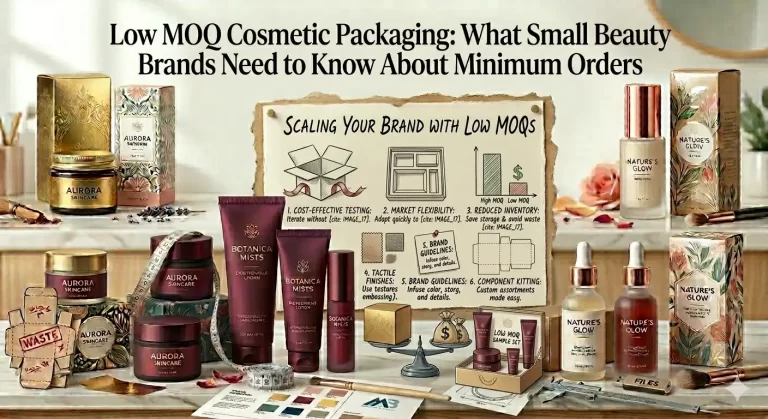
Low MOQ cosmetic packaging solves all of these problems by bringing the entry point down to a level that reflects the reality of how small brands actually grow.
What “Low MOQ” Actually Looks Like in Practice
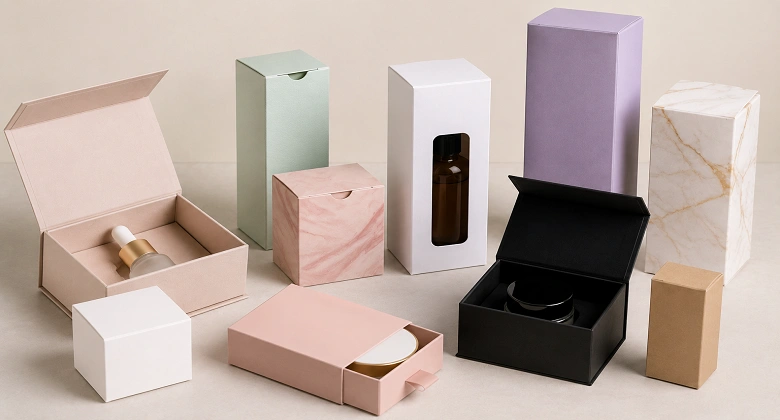
The definition of “low” varies by supplier and product category. In general terms, anything under 500 units is considered low MOQ in the cosmetics packaging space. Some suppliers including Make A Boxes offer runs starting from as few as 100 units.
That number matters enormously. At 100 units, a founder can:
- Launch a true pilot run and test customer response before committing to a larger order
- Offer a limited edition without overproducing
- Test multiple colorways or formats simultaneously across small batches
- Keep their upfront packaging investment under control while they build revenue
The key is finding a small batch beauty box supplier that has genuinely built their production model around smaller runs, not one that reluctantly offers a low minimum as a premium upsell while optimizing their entire operation for bulk.
What to Ask Before Signing with a Cosmetic Packaging Supplier
Not all low-MOQ suppliers are created equal. Before committing, get clear answers on the following:
1. What is included in the minimum order?
Some suppliers advertise a low MOQ but exclude custom printing, foiling, or structural customization until you hit a higher threshold. Make sure the quote you’re comparing includes the exact specifications you need, not just a plain box at minimum volume.
2. What are the setup or tooling fees?
Custom dies, print plates, and embossing tools cost money to create. These are often charged separately from per-unit costs. A supplier quoting a low unit price might still represent a high total investment when setup fees are factored in. Always ask for the total cost of the first order, not just the per-unit rate.
3. What are lead times at low volumes?
Some manufacturers prioritize high-volume orders in their production queue, so small orders can sit for weeks. If you’re launching on a specific timeline, ahead of a product drop, a trade show, or a holiday campaign, lead time certainty is non-negotiable.
4. Can you see samples before committing?
Physical samples let you check print registration, structural integrity, unboxing feel, and color accuracy before you sign off on a full run. Any reputable supplier should offer this. Be cautious with those who don’t.
5. How does reordering work?
If your first batch sells out, which is the goal, how quickly can you reorder? What’s the minimum for a reorder? Will your plates and artwork be retained so you don’t pay setup fees again? These questions matter as much as the initial MOQ.
Customization Options Available at Low Minimums
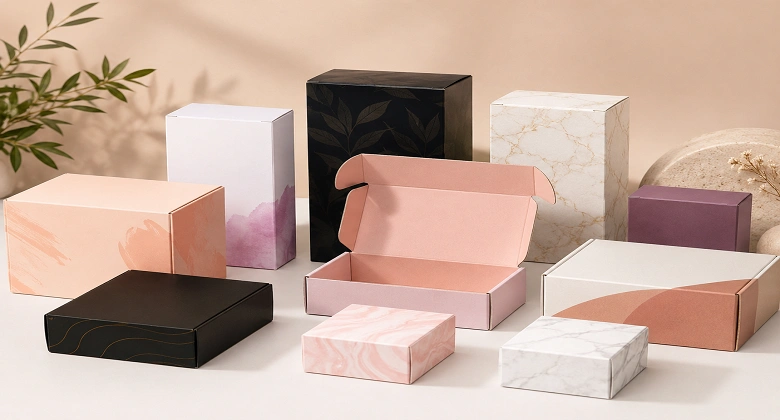
One of the most persistent myths about low-MOQ packaging is that you have to sacrifice customization. In reality, a good supplier can deliver a fully branded, premium-feeling package at 100 units.
At Make A Boxes, our minimum order custom cosmetic boxes include access to a range of finishes and structural formats that let small brands compete visually with players spending ten times more on packaging:
- Print finishes: Gloss lamination, matte lamination, soft-touch coating, spot UV
- Premium effects: Foil stamping in gold, silver, rose gold, and holographic; embossing and debossing for tactile brand marks
- Structural options: Tuck-end boxes, magnetic closure boxes, sleeve and tray constructions, and custom inserts for product protection
- Material choices: FSC-certified kraft, premium white board, and recycled stock options for sustainability-focused brands
These aren’t stripped-down versions of what bigger brands get. They’re the same finishes, the same quality, and the same structural options, at a minimum order that works for where you actually are right now.
How to Calculate the Right Order Quantity for Your Launch
Even when low minimums are available, it’s worth thinking strategically about how many units to order. More is not always better, especially at launch.
Start with your realistic sell-through target. How many units do you expect to sell in the first 60 to 90 days? Be conservative. Your packaging quantity should match your honest near-term sales projection, not your aspirational one.
Factor in your sales channels. Selling direct-to-consumer through your website gives you more control over pacing. Wholesale or retail placement typically requires you to have more stock on hand and may compress your sell-through window.
Account for damage and gifting. A small buffer, typically 5 to 10 percent above your sales target, covers products sent to press, influencers, or damaged in transit.
Think in reorder cycles. Rather than trying to order enough packaging for six months in one go, consider ordering for eight to twelve weeks and building your reorder cadence as you understand your actual velocity. Lower initial commitment, less risk, faster learning.
Why the Indie Beauty Market Demands Better Packaging Partners
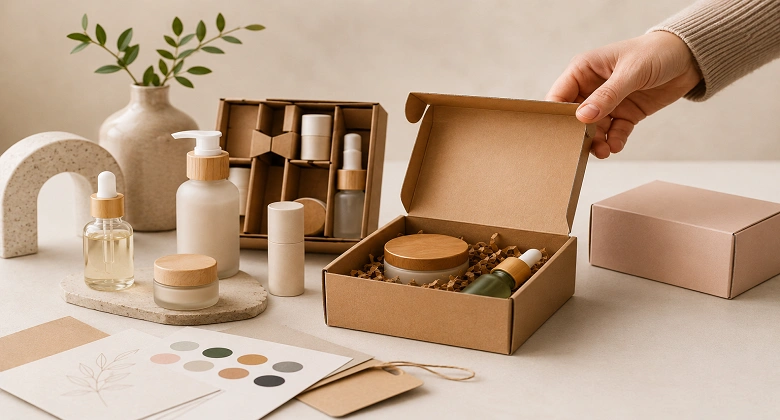
The indie beauty space has fundamentally changed the packaging industry’s power dynamics, but many traditional suppliers haven’t caught up.
Indie brands are now responsible for some of the most influential aesthetic trends in beauty. They’re outperforming legacy brands on social engagement. They’re driving conversations about sustainability, ingredient transparency, and packaging design. And they’re doing it, in many cases, with far less capital than a traditional launch would have required a decade ago.
The packaging industry needs to meet this market where it is, not ask it to behave like a mass-market brand before it’s ready.
That’s the premise Make A Boxes was built on. Our 100-unit minimum isn’t a concession or a workaround. It’s a deliberate choice to serve the segment of the market that’s generating the most creative energy in beauty right now: founders with great products, clear brand visions, and zero interest in overcommitting to inventory before they’ve earned it.
Green Packaging and the Low-MOQ Opportunity
Sustainability is no longer a differentiator in beauty; it’s a baseline expectation, especially among the consumers most likely to support indie brands. The good news: low-volume production is inherently more aligned with sustainable practices than mass manufacturing.
Smaller runs mean less waste. They allow brands to update packaging more frequently as materials improve. They reduce the risk of obsolescence-driven disposal.
At Make A Boxes, we offer FSC-certified materials and recyclable board options across our custom range. Communicating your packaging’s sustainability credentials, material sourcing, recyclability, reduced plastic is increasingly valuable to beauty consumers, and it starts with choosing a supplier who can back those claims with documentation.
Making Your First Packaging Order: A Practical Checklist
Before you place your first order, run through this:
- Confirm your MOQ and total first-order cost including setup fees
- Request physical samples and approve them before signing off
- Verify lead time against your launch date with a buffer built in
- Confirm your artwork specifications and get a digital proof
- Clarify reorder terms, plate retention, and turnaround for repeat runs
- Check material certifications if sustainability claims matter to your brand
- Understand the returns or remake policy in case of production errors
Your Packaging Shouldn’t Be the Reason You Wait
Every week, a great product sits unlaunched because its founder is waiting to afford a 5,000-unit minimum, a week that the founder’s competitors, some with inferior formulas, are building market share.
Low MOQ cosmetic packaging exists to close that gap. It gives small brands the ability to show up professionally, test the market intelligently, and grow without being locked into inventory decisions that don’t match their stage of business.
Make A Boxes offers custom cosmetic packaging from 100 units, with the full suite of finishes, structures, and print options that indie beauty brands need to stand out on shelf and online. If you’re ready to take your product from formula to fully branded, we’re built for exactly where you are.
Ready to place your first order? Get a free, no-obligation quote from Make A Boxes and see exactly what your first 100-unit run would cost.
Frequently Asked Questions
Make A Boxes offers custom cosmetic packaging from as low as 100 units, one of the lowest minimums available among US-based cosmetic packaging suppliers. This includes access to custom print, premium finishes like foil and soft-touch, and a range of box structures, making it viable for indie brands at any stage of growth.
You don't have to compromise. At Make A Boxes, even orders starting at 100 units have access to the full range of customization options, including gloss or matte lamination, spot UV, foil stamping, embossing, and custom structural formats like magnetic closure or sleeve-and-tray boxes.
A good rule of thumb is to order based on your realistic 60–90 day sell-through projection, not your best-case scenario. Add a 5–10% buffer for gifting, press samples, and transit damage. Starting conservatively protects your cash flow and lets you reorder once you understand your actual sales velocity.
Yes, provided the supplier offers the right finishes and structural integrity. Packaging from Make A Boxes meets retail presentation standards, including barcode placement support, shelf-ready structures, and print quality consistent with what buyers expect from professional beauty brands.
Always compare total first-order cost, not just per-unit price. Ask about setup and tooling fees, whether customization is included at minimum volumes, lead times for small runs, and what the reorder process looks like. A low headline MOQ can still represent a high total investment if setup costs aren't disclosed upfront.
