
Condensation: The Failure Nobody Plans For
Chilled drinks sweat, and beverage packaging absorbs it. A bottle or can taken from a fridge to a warm room collects water on its outer surface within minutes, and that water goes straight into whatever is holding it.
Paperboard loses stiffness as it absorbs moisture. In practice, that means the handle of a carrier tears through, a base panel bows and releases its contents, or a printed panel blisters, all while the pack is doing nothing more demanding than sitting on a counter. It is the most common beverage packaging failure and the one least likely to appear in a specification, because a dry sample in an office behaves perfectly.
Three responses work. Specify a moisture-resistant coating on the outer surface, not just the inner. Use a heavier caliper than the dry weight of the product would suggest, since the board will be working wet. And test a filled sample after an hour out of a fridge rather than straight off the bench; that is the condition the pack actually fails in.
Weight, Base Strength and Handles
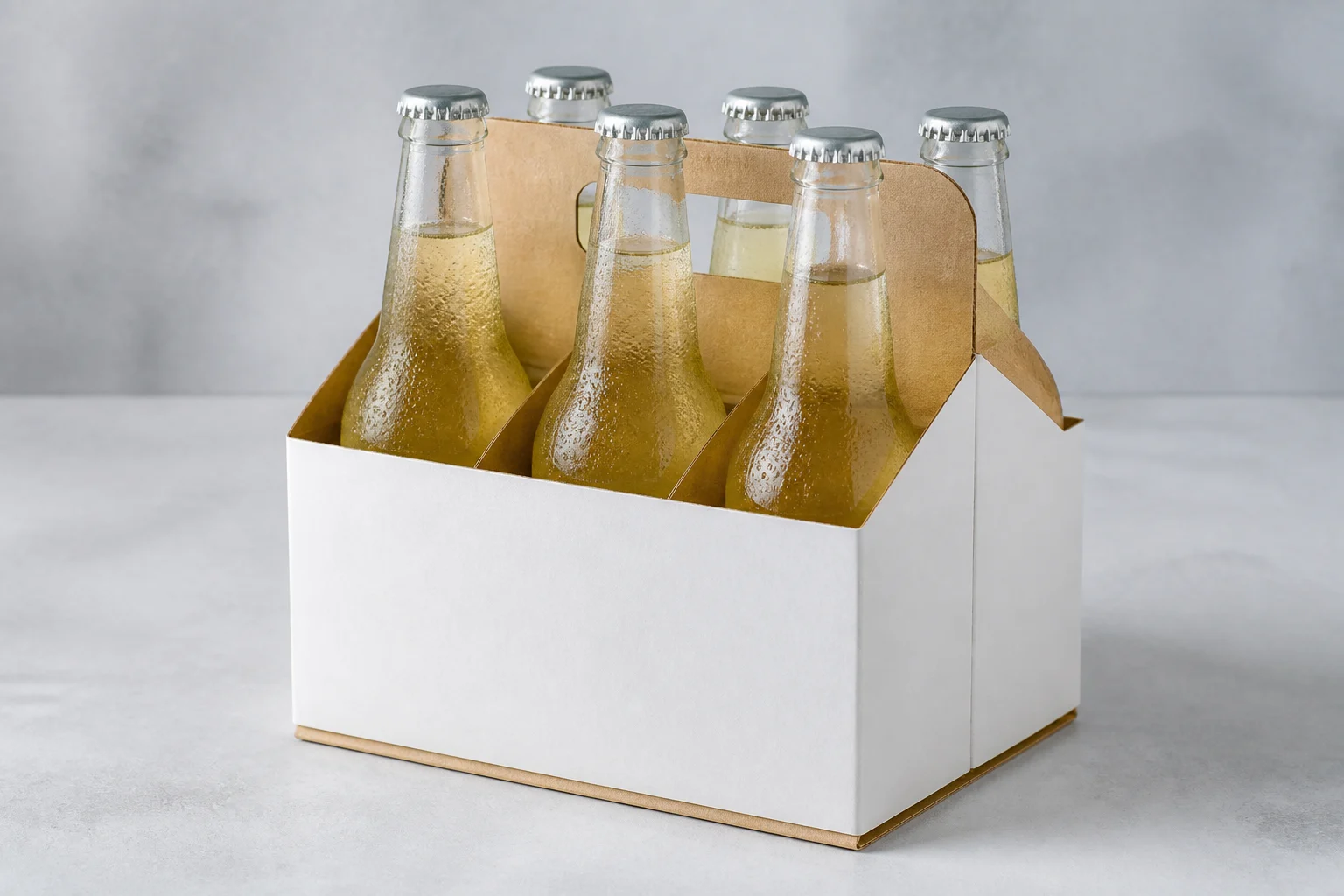
Liquid is dense, and beverage packaging carries that load in a small footprint. A six-pack of 500 ml bottles is heavier than almost anything else a customer will carry out of a store in a paperboard pack, and that weight is concentrated in a small footprint with a high center of gravity.
Two structural details carry the load. The base has to resist bowing under sustained weight rather than momentary impact, which usually means a reinforced or auto-lock bottom rather than a simple tuck. And any handle is a stress concentration, the point where the entire mass acts on a small area of board, which is precisely where moisture from condensation weakens it fastest.
If a pack has a handle and holds chilled product, specify the handle area for wet strength rather than dry. It is the single most common point of failure in custom beverage boxes, and it is cheap to prevent at the design stage.
Drink Carriers
Drink carriers do a job no other beverage packaging does: they hold multiple containers upright and separated while being carried by one hand, usually by someone also carrying food.
Cup carriers for hot drinks need rigidity in the cavity so a cup cannot tilt, and they face the opposite moisture problem from cold drinks: steam and spillage from the top rather than sweat from the side. Bottle and can carriers need divider strength between units, because glass striking glass is the failure mode once a carrier is in motion.
For both, the thing to test is not the carrier full and stationary. It is the carrier full, carried at walking pace; with one unit removed, an unbalanced carrier behaves completely differently from a full one, and that is the state most of them are in by the time they reach a table.
Custom Beverage Boxes: Which Structures Work?
| Structure | Best For | Strength | Watch For |
|---|---|---|---|
| Basket carrier | Bottles, cans, multipacks | Handle plus dividers | Handle tears when damp |
| Wrap-around carton | Retail multipacks | Tight, stackable, efficient | Needs consistent container size |
| Auto-lock base carton | Single bottles, gifting | Strong base under weight | More board per unit |
| Cup carrier tray | Hot drinks to go | Holds cups upright | Cavity fit must be exact |
| Rigid gift box | Premium single bottles | Presentation and protection | Does not ship flat |
| Shipper with insert | Ecommerce orders | Immobilizes glass | Adds dimensional weight |
Current formats and finishes are on our beverage packaging page.
Jar Packaging Boxes
Jar packaging boxes sit between retail presentation and genuine transit engineering. Sauces, preserves, honey, pickles, nut butters, and most brands specify one and get caught by the other.
A single jar in a retail carton needs a snug fit and enough board to keep the shape on a shelf. That is straightforward. The moment jars travel in multiples, the requirement changes completely: the dominant risk is no longer the box wall but the neighboring jar, because glass strikes glass far harder than it strikes board.
Every multi-jar layout therefore needs a divider between units rather than only around them. That is true at two jars, and it is true at twelve. Our jar packaging covers single and multi-unit formats, and the specification question worth asking is always what separates the units, not what surrounds them.
Shipping Jarred Goods Direct to Customers
Ecommerce is where jarred food packaging gets expensive to get wrong, because one breakage contaminates everything around it. A corrugated shipper with a fitted insert that holds each jar centered and clear of the outer wall is the baseline, and half an inch of standoff on every face is a workable target.
Two additions specific to food that a non-food product would not need. Consider a sealed inner bag or wrap around each jar so breakage is contained rather than spread; it costs very little and changes a total loss into a single-unit loss. And check the closure: a lid that loosens under vibration leaks without breaking anything, which is harder to diagnose and just as damaging.
Glass Jar Packaging and Breakage
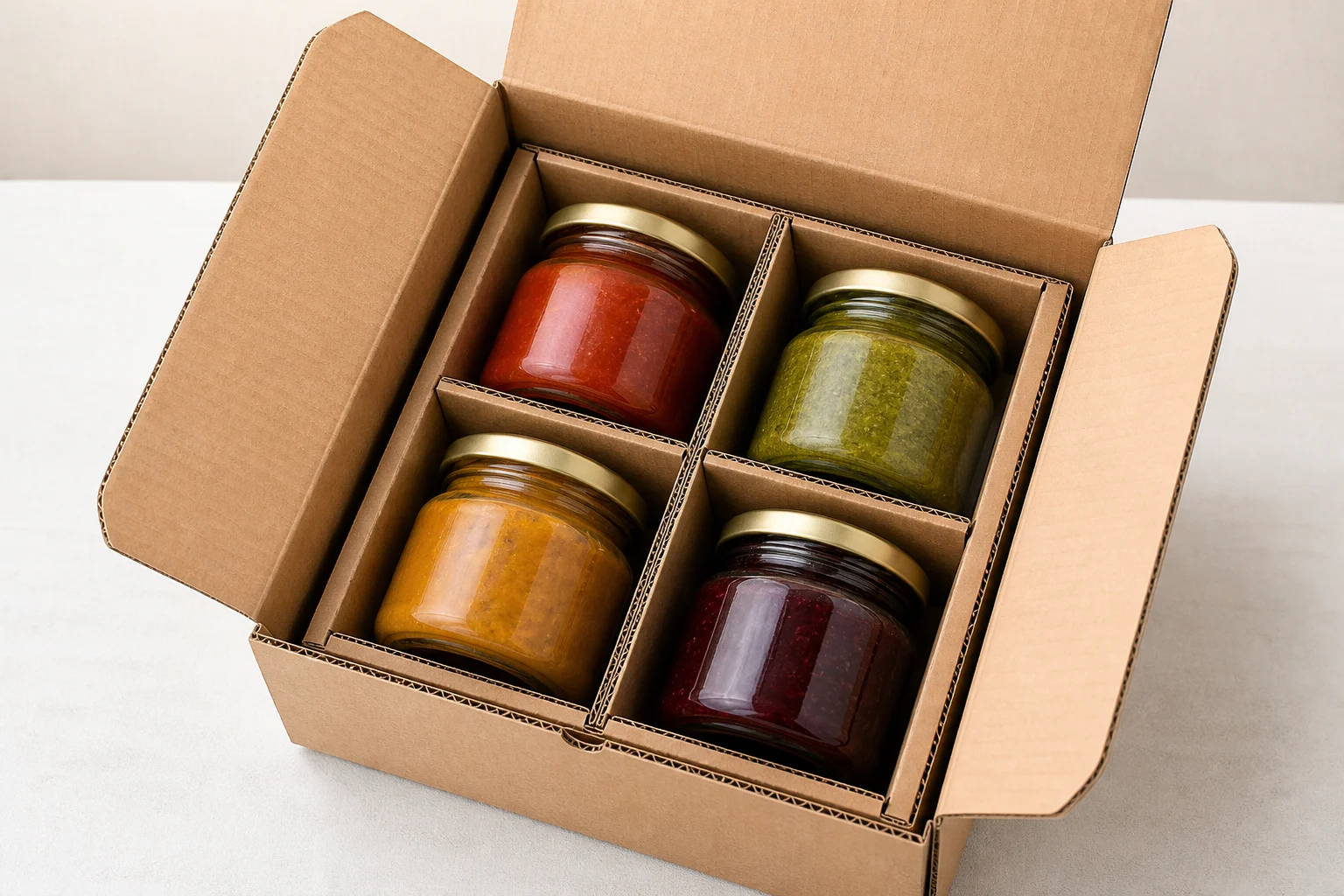
Glass jar packaging fails suddenly rather than gradually, which means the design question is not how much protection to add but where the force goes.
Three points matter. Clearance between the glass and every outer surface turns an impact into a survivable event, because a jar touching the wall receives the force directly. Immobilization matters more than cushioning; a jar that can travel even slightly will do so thousands of times across a long journey and arrive chipped at the rim even if it never breaks. And the base is where weight concentrates, so a shipper’s base needs more attention than its sides.
Alternatives are worth considering before committing to glass at all. If the product allows it, a lighter container removes the entire problem, and the packaging savings over a year of shipments is usually larger than the container cost difference.
Test the Complete Jar Package Before Distribution
Evaluate the jar, closure, label, divider, cushioning, retail carton and shipping case as one packaging system. Testing an empty box does not show how the completed package will respond to impact, compression or vibration.
Begin with practical sample checks:
Confirm that jars cannot strike each other
Check clearance between the glass and every outer wall
Inspect the base and dividers after carrying and stacking
Test the closure for loosening or leakage
Examine labels after condensation exposure
Repeat testing after changing the jar, divider or box dimensions
For commercial distribution, select a test procedure that reflects the actual shipping environment. The International Safe Transit Association’s test procedures distinguish between basic screening tests and simulations of transportation hazards.
Testing cannot guarantee that every shipment will arrive undamaged, but it can identify weaknesses before they affect a complete production run.
Bottle Packaging Boxes
Bottles add a geometry problem to the weight problem: they are tall, narrow, and top-heavy, which makes them prone to tipping inside any pack with spare room.
Neck and shoulder support is what stops that. An insert gripping the body alone lets the bottle rock; one that locates the neck holds it vertical. For gifting formats, that support also determines the reveal: a bottle that has to be wrestled out of a tight cavity spoils the moment the packaging was bought for.
Labels, Tamper Evidence and Print
Three details that cause disproportionate trouble in this category.
Label adhesive has to survive condensation. A label applied to a bottle that will be chilled needs an adhesive rated for damp surfaces, or it lifts at the edges and looks like a returns problem.
Tamper evidence is expected on food in jars and increasingly on beverages. Build it into the structure or the closure rather than adding a sticker at the packing bench, where it becomes a step someone skips during a rush.
And print on beverage packaging competes with the container itself. If the bottle or jar is attractive, a window or a partial wrap that reveals it usually outperforms full enclosure; the product is doing selling work that a printed panel would hide.
Cold, Frozen and Hot-Fill
Temperature adds one more layer to beverage packaging. Liquids expand when frozen, so any product intended to be frozen needs headspace designed in and a container specified for it; a full glass jar in a freezer is a breakage waiting to happen.
Hot-fill products create the opposite issue: the container and closure have to tolerate filling temperature and then the vacuum that forms as contents cool. And chilled or frozen distribution puts the outer packaging through the moisture cycling covered in our guide to frozen food packaging requirements, where condensation on every cold-to-ambient handover is the thing that degrades board over time.
Container and packaging components must be verified for their actual conditions of use. A material suitable for refrigerated storage is not automatically suitable for freezing, hot filling or reheating. The FDA’s food-contact conditions-of-use guidance distinguishes among refrigerated, frozen, hot-filled and heated applications. Our food-safe packaging materials guide explains what supporting documentation to request.