

Every business delivers its products through shipping, which makes packaging boxes a critical part of the supply chain. Boxes are not only used to contain products but also to shield them from damage during handling, storage, and transportation. For this reason, selecting the right box is essential. A box that does not match the product dimensions can increase cost, reduce protection, and create operational issues.
Businesses choose box sizes based on their specific product requirements. The goal is to use a container that carries the products properly. Neither oversized nor undersized companies measure their product carefully and use custom-sized packaging to match those measurements. Understanding how to measure a box for shipping helps reduce product movement inside the box, lowers the risk of damage, and prevents unnecessary financial loss.
Choosing the right box size for shipping also affects storage efficiency and expense. Larger boxes occupy more warehouse space and require additional void-fill materials such as paper fill, air pillows, or bubble wrap to stabilize the product. These extra materials add to the overall packaging costs. In addition, oversized boxes can increase shipping charges, especially in international shipments where dimensional weight and customs-related fees apply.
This shipping box measurement guide explains why box size plays a major role in container loading efficiency, particularly when shipping in 20-foot to 40-foot containers, and how right-sized packaging supports safer and more cost-effective transportation.
Why is Finding the Right Box Size Crucial to Businesses?
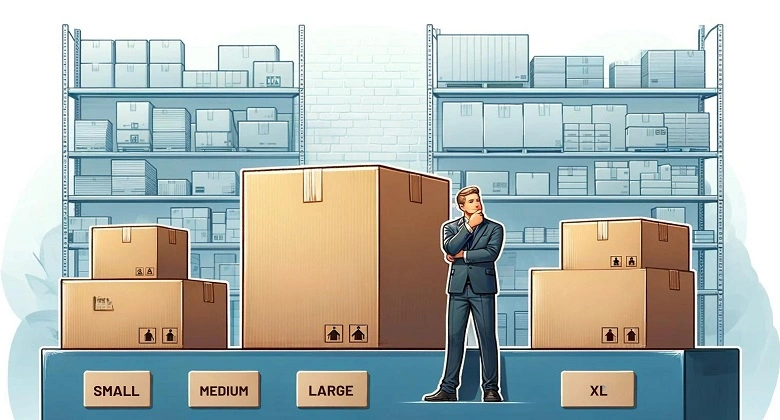
Finding the right box size has become increasingly important as businesses expand into global and online markets. eCommerce companies, in particular, ship products in large volumes and require packaging solutions that can handle frequent handling and long-distance transportation. Instead of relying on fixed or standard box sizes, many businesses now prefer customized box dimensions that match their specific product requirements. As a result, box sizes vary based on product shape, weight, and containment capacity.
Using an incorrect box size increases the risk of structural failure during transit. Boxes that are too large may collapse, while undersized boxes can burst under pressure, causing products to spill, break, or become damaged. These incidents lead to financial losses, higher return rates, and operational disruptions. To avoid such risks, businesses carefully evaluate both the internal and external dimensions of their boxes to maintain balance and structural integrity.
Accurate box sizing also plays a key role in protecting a company’s brand image and reputation. Damaged packaging or broken products create a negative customer experience and reduce trust in the brand. For this reason, businesses now focus on precise internal spacing, proper sealing, and reliable box construction. Custom-sized packaging allows organizations to transport their goods more safely, reduce damage-related losses, and maintain consistent quality throughout the shipping process.
How to Measure the Right Box Size for Shipping?
In the field of logistics and transportation, everything needs to be perfect. However, businesses find themselves measuring their packaging boxes with their proper inching tapes. They calculate the interior and exterior of the design to increase the space and capacity. Spacing is the basic need for boxes to be airy and voluminous, which gives them a better protection solution. Companies want their boxes to be wide in space to prevent leakage. Their calculations are based on the exact formula of dimensional weight. It is known as a shipping box size calculator to examine the accurate shape and design.
Dim Weight = Length X Width X Height/DIM Divisor
All the leading couriers and carriers of the world, such as FedEx, UPS, and DHL, measure their boxes according to this formula. Hence, the explanation of dimensional weight gives the complete measurement of the length, width, and height of a product. It provides the total sum of the occupied volume of an item inside the container.
This whole formula can be calculated so easily with the help of putting the values in it to find the result. In this equation, length and width define the horizontal area of the box from the inside. At the same time, height is the only factor that shows the vertical capacity of the shipping container.
The value of a dimensional weight is becoming increasingly important nowadays in the field of shipping and logistics. It shows the spacious volume and capacity of a product inside the box. This occupied space is entirely different from the actual weight of the packaging container. Because it only measures the correct shipping box dimensions of the area inside.
Cost of Shipping Air for E-commerce
The term shipping air is very common in the field of packaging design for businesses. However, they refer to the internal air and space of their occupied product. Products must leave some space inside to fill the void with bubble wrap or paper. Some companies also use air pillows to provide a guard against damage.
Although these materials seem cheap, they are still very expensive and add up to hundreds of thousands of dollars in high-volume shipping. Businesses mostly use the corrugated cardboard material for its long-term durability and sustainability features. It is also good for health and can easily be decomposed in landfills for recycling. Modern ecommerce companies believe in using smaller boxes to handle them easily.
Increase in Labor Charges
Laborers also charge higher for wrapping these boxes for packaging. Especially the larger ones, to consume more precious time in this job. It takes them more time to tape the whole box from several places to ensure the safety of the items inside. Workers use tapes on the middle and all corners of the boxes from the front and rear sides. Furthermore, they also have to add the cavity to protect the goods from damage. It is because a little shake or hit can make a lot of difference in a noise.
Businesses find it a risk to carry and convey these boxes to their actual customers to whom they belong. So, they must be careful about everything and examine the appearance of the box before transporting it in the trucking carrier. These trucks are also robust metal-designed with a lot of space in their containers to accommodate the bulk of packaging stuff.
Understand the Right Product Measurement
Companies do not rely nowadays on the standard shipping box sizes. So, they do their own planning and strategies for measuring a box for shipping. It takes them a proper physical toolkit for calculating the exact size of the packaging box for delivery. Businesses hire workers to use the ruler or inching tape to do the accurate measurement. Thus, they note their calculations on the paper to do it exactly.
Use the 2 Inch Rule
It is a standard rule of spacing inside the box. This rule reveals the idea of leaving a two-inch gap on the right and left sides of the product to save it from a hit. Most businesses use this rule in packing clothes and fabric items. They use the vacuum seal to take the air out, reducing the shape and size of the box.
However, in high-value items, this rule changes to 3 inches. It is because of the serious risk of damage to fragile items in the box. These items involve all crystal glass decorations and electronic items, such as laptops and tablets, that are sensitive. Companies keep their three inches of padding to safeguard these goods from being broken. They use two boxes, one inside the other, stuffed with added softening materials to minimize risk at all. This box is a bit heavy to carry, but safe and secure by all means. In case of a fall, it will keep the items unharmed due to heavy cushioning all around.
Step-By-Step Guide On How To Choose The Right Box Size For Shipping Products

Here are a few valuable steps on selecting the right box size for shipping:
- Measure Your Products Accurately
Companies can make their beginnings by choosing their products and fitting them into the boxes snugly. So, there must be a sense of comfort in placing the goods inside the packing containers. Businesses should take the accurate measurement of their items with their inching tapes or rulers. They cannot afford the cost of larger shipping boxes to turn them into waste.
They must hire experts who can calculate the occupied length, width, and height of a product after fitting into the box. Workers must remember to measure their calculations in inches, which is the smaller unit of measurement for shipping. After that, they can also add their retail packaging attachments and price labels on the boxes with bar codes. They must mark the tallest and widest points inside and outside the shipping box. Businesses can round up their calculations to half an inch or a quarter to get the perfect size.
- Add Padding Allowance
After measuring the products correctly, it is time to add the padding allowance. It is famous for its two to three inches of gap on both right and left sides. This void space is used to stuff cushioning materials inside the box. But it is mainly disliked in the business community. All entrepreneurs are of the view that the custom creation of their packaging boxes is essential. So, they can be according to their own set of requirements.
Businesses can use several kinds of softening materials that suit their needs and requirements. They most commonly use bubble wrap to cover each item separately against attack and collision. A bubble wrap is made of plastic and polyethylene sheets containing air bubbles that burst when a hit or a shock happens. It saves the box from sudden impact and vibration. They are ideal for both non-fragile and fragile goods. It takes 2 inches of space for simple items and 3 inches for the most delicate items that can have a risk of being broken.
- Choose the Right Cushioning Materials
Organizations must select the accurate cushioning materials prior to choosing the box size. So, the most common types of protective materials are as follows:
- Bubble Wrap
- Foam Inserts
- Paper Fill
- Air Pillows
Businesses can keep a gap of one or two inches to use these fillers inside their box to protect fragile items. But when using a custom-fit box, there is no such need for these materials. It is because they only work for larger boxes that have more space in their containers. These protective materials also come with their distinctive features, which set them apart from others. For instance, the use of bubble wrap is highly recommended for shock absorption.
Likewise, foam inserts are ideal for custom protection of goods against damage. Paper fill is an eco-friendly void filler that is an excellent filler for vacuum space. Last but not least is an air pillow, which is used for lightweight space filling for both fragile and non-fragile items in transit.
- Evaluate the Product’s Fragility
The fragility of any product can be easily determined by its extreme level of delicacy and weakness. So, it can be broken with a slight blow or hit. It is also very sensitive to compression and vibration. Examples are glassware and crystal decorative items that are highly expensive in the market. These decorative items are mostly ordered from abroad to set them in the house as a showpiece for guests.
When packing these sensitive items, care has to be taken and cushioning materials used to save them from damage. Tiles and ceramics also come under this category and need a lot of care and attention in their handling. So, after determining the check and examination, it is essential to safeguard these goods from being broken down into pieces.
- Calculate the Internal Box Size
Companies need to calculate and measure the size of their internal box. It is a space where they store their precious items. So, they must be highly protected against harm and damage to deal with a loss. For example, the standard product size is 10x6x4 inches in its length, width, and height, respectively. Businesses can add a cushioning filler of one inch on each side to keep the protection. However, the ideal internal box size is 12 x 8 x 6 inches, which is an ideal custom fit for packaging boxes. Businesses must measure the volume and capacity correctly before fitting their items into the box. It determines the occupied space of a product in a container.
Find the Box Strength
The strength of the box is determined by its sense of sustainability and durability. So, it can pass through a tough ECT test. It is popularly known as the edge crush test, which shows the handling of force and pressure before hitting the ground. Another test is the same, which is called the burst test, which evaluates the puncture or rupture in the box after piercing the sharp object inside it.
Companies must design their packaging boxes after checking their strength against transit pressure and stacking compression to withstand the heavy weight on them. It is like keeping the stack of boxes one above the other to sustain the burden.
Organizations can have the solution to handling these pressures by using these kinds of boxing:
- Single Wall
- Double Wall
- Triple Wall
A single wall is a thin and normal layer of material used for non-fragile items. It is ideally recommended for soft items such as fabrics and clothes. They can be bedsheets, pillows, or anything that is not fragile and breakable.
Double Wall is highly recommended for delicate and sensitive goods such as glassware, crystal decorations, electronic devices, and medical instruments. It can also be vases, art, sculptures, and jewelry. These items are packed inside a dual layer of thick material and stuffed with cushioning all around them to keep them safe.
Finally, a triple wall is for industrial goods. They are heavy-loaded items that need a lot of care and safety. All of these boxes should be made of corrugated cardboard to ensure the health of the environment.
Decide to Choose from Standard or Custom Boxes
It mainly depends on the personal choice of a business to select a standard or a custom box according to their own needs and requirements. This works on the philosophy that not all sizes fit the same. However, in this context, it is necessary to evaluate the accurate shape and size of a packaging container and measure it thoroughly from inside and outside.
However, there are some other perquisites for using custom boxes for packaging, such as:
- Saving Long-term Money
- Elevates the Brand Reputation
- Matches the Dimension and Protection
- Reduces the shipping costs
- Creates the unboxing experience
The need for custom boxes arises when companies prefer shorter sizes of their packaging containers. They do not want the extra waste of materials, which ultimately results in carbon emissions.
Determine the Actual Weight of a Product
Companies need to evaluate the real weight of a product right before putting it inside the shipping box. It is because the strength of a box depends on the weight, and all the carriers also charge their expenses on them. They check the difference between an actual or occupied space inside the box packaging. Businesses must use a digital scale to note down the weight for their own reference.
The higher burden of a weight directly affects the cost of a carrier. So, obviously, they charge higher for heavier products in their cartons for shipment.
Find the Impact of a Dimensional Weight
Organizations must calculate the dimensional weight of a product. It is an occupied space of a product inside the box. This carries its own impact on the whole container to ship it abroad. However, businesses must learn the formula well for adding the (length x width x height) / carrier DIM factor. It simply means that if the actual weight of a good is higher than its dimensional weight, the passenger will have to pay more for it.
It uses a smart technique of making a comparison of boxes and choosing the smallest one to give a proper sense of protection against harm and damage.
Conclusion
Hence, in a nutshell, the above-mentioned are essential points to learn and understand about choosing the right box size for shipping products. Selecting the accurate packaging box can save a tremendous amount of costs and expenses. It gives a customer’s peace of mind to satisfy their requirements.